Alan Turing and Bletchley Park: codebreaking and computing
At Bletchley Park, Alan Turing and thousands of colleagues read enemy messages at scale. Their work helped shape the war and the computer age.
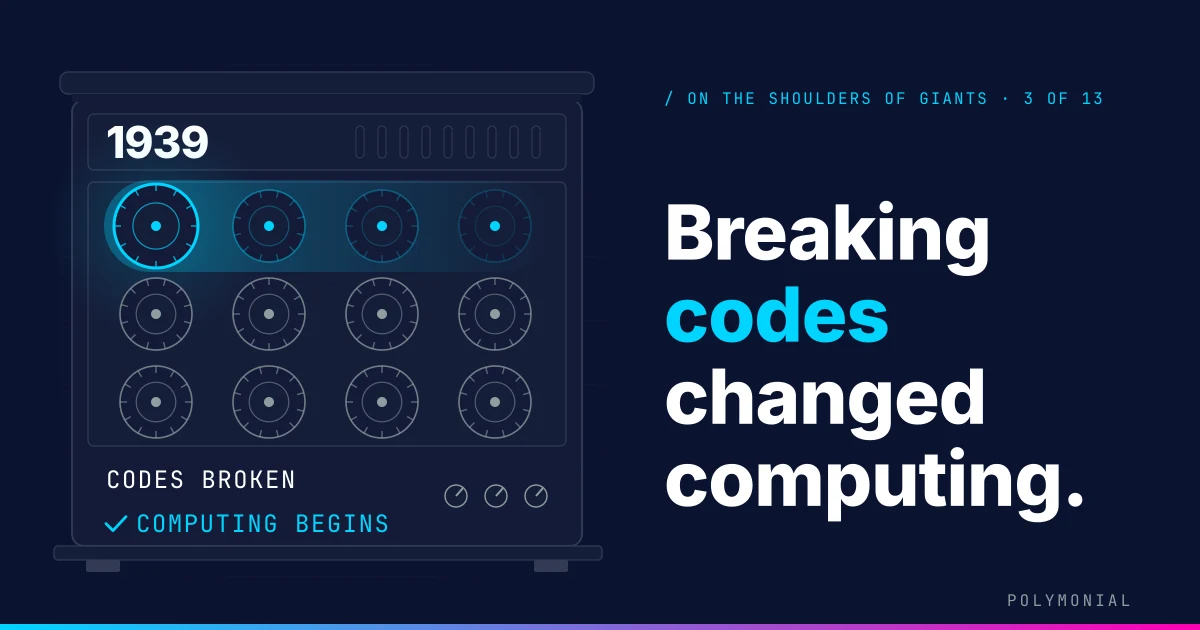
On the shoulders of giants, part three of thirteen.
In the summer of 1939, weeks before war broke out, three Polish mathematicians, Marian Rejewski, Jerzy Różycki and Henryk Zygalski, shared years of work with British and French intelligence. They had found ways to read messages from Enigma, the cipher machine the German armed forces relied on. The British took that work to a country house in Buckinghamshire called Bletchley Park.
The problem
Enigma looked like a typewriter. Each key press sent an electrical signal through a set of rotating wheels and lit up a different letter. The wheels stepped with every letter, so the same letter was scrambled differently each time. Operators changed the machine's settings every day, and the number of possible settings was far too large to try by hand.
The German forces were confident it could not be read. Kerckhoffs would have recognised the risk. Once the design of the machine was understood, as the Polish team had worked out, everything rested on the daily settings, the key, and on how carefully operators used them.
Turing's contribution
Alan Turing arrived at Bletchley Park in September 1939. He was twenty-seven, and already known for a paper published in 1936 that described, in the abstract, a universal machine able to carry out any calculation that could be written down as a set of rules.
At Bletchley he helped turn the Polish methods into something that could work at the scale of a world war. He designed the Bombe, an electromechanical machine that tested possible Enigma settings against a guessed fragment of a message and ruled out the impossible ones far faster than people could. Gordon Welchman added an improvement that made it far more effective. By the end of the war, Bombes were running around the clock.
Turing also led the work on naval Enigma, the hardest version, which protected the traffic of the U-boats in the Atlantic. Reading it helped steer convoys away from the submarines hunting them.
Codebreaking at industrial scale
Bletchley Park was never one genius. It grew into an organisation of thousands of people, mathematicians, linguists, engineers, clerks and machine operators, most of them women, working in shifts day and night. Intercepted messages arrived, were broken, translated, analysed and passed on, every day. The intelligence they produced, known as Ultra, was among the most closely guarded secrets of the war.
From codebreaking to computing
Not every German cipher was Enigma. The high command used a teleprinter cipher, codenamed Tunny by the British, that combined each message with a stream of key, the same principle Gilbert Vernam had introduced in 1917. But Tunny's key was generated by machine rather than taken from a truly random tape, and machines leave patterns.
Bill Tutte worked out how the machine produced its key without ever seeing one. Exploiting that took more speed than people or electromechanical machines could offer. Tommy Flowers, an engineer at the Post Office's research station, built Colossus, which was working by early 1944 and is recognised as one of the first programmable electronic digital computers.
After the war Turing turned to building computers, with designs for a stored-program machine and work at Manchester, and to the question of whether machines could think. Much of what had happened at Bletchley stayed secret until the 1970s, so the full story was told only decades later.
Turing's legacy
Turing died in 1954, two years after a prosecution for his sexuality under the laws of the time. The British government apologised in 2009, and he received a posthumous royal pardon in 2013. Today he is recognised as one of the founders of computer science, and his portrait appears on the Bank of England's fifty-pound note.
What it teaches
Bletchley Park's lesson reaches well beyond the war. The machines it fought were strong in design and weak in use: repeated settings, predictable message openings, operators taking shortcuts. Protection fails where people and process meet the method. And the effort to read other people's secrets helped create the computers that now hold everyone's. Every organisation protecting data today works in a world Bletchley helped to build.
Next in the series: Shannon (1949), and what perfect secrecy means.
Join the waitlist for early access.
Related Posts
Kerckhoffs's principle (1883): the secret is the key
In 1883 Auguste Kerckhoffs argued that a cipher should stay safe even if the enemy knows how it works. It still shapes how security is judged.
Read More ›
The one-time pad: Vernam, Mauborgne and the perfect cipher
A teleprinter cipher from 1917, made perfect by one rule: a truly random key, used once. It can never be broken, and it comes with a catch.
Read More ›
William Friedman: when codebreaking became a science
Around 1920, William Friedman showed how counting coincidences between letters could break ciphers, and brought rigorous statistics into codebreaking.
Read More ›
Trust that travels.
Secure, trusted and under your control.