The one-time pad: Vernam, Mauborgne and the perfect cipher
A teleprinter cipher from 1917, made perfect by one rule: a truly random key, used once. It can never be broken, and it comes with a catch.
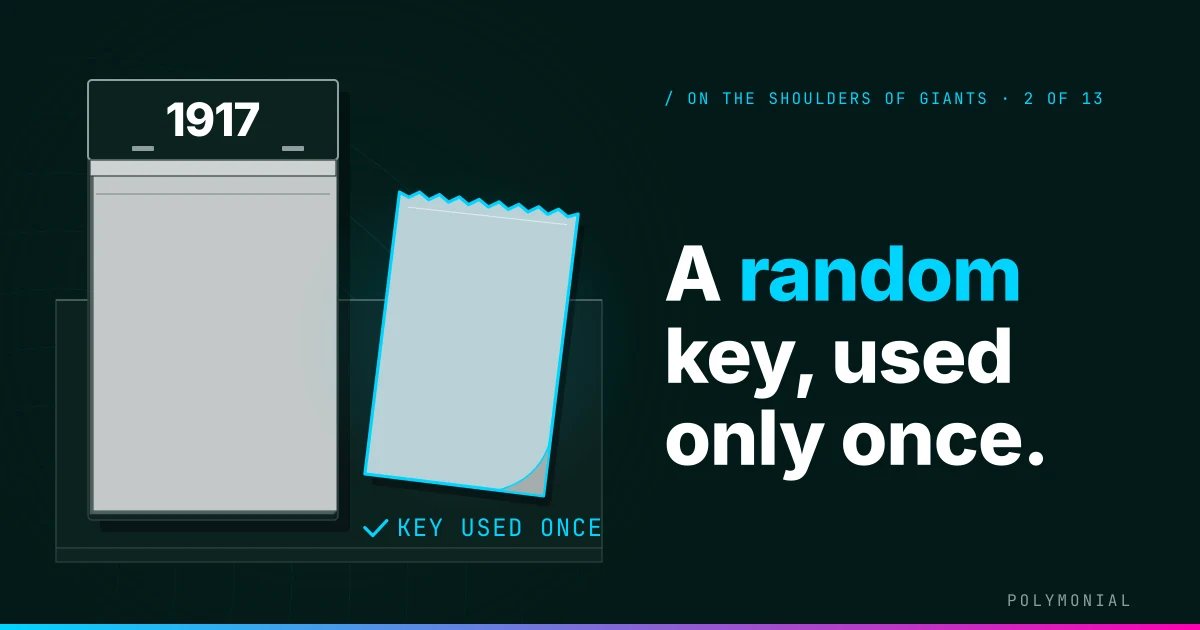
On the shoulders of giants, part two of thirteen.
In 1917, an engineer at an American telephone company named Gilbert Vernam was working on a practical problem. Teleprinters had begun to carry messages over wires as a series of electrical pulses, punched into paper tape as patterns of holes. Anyone who could tap the line could read the traffic. Vernam wanted a way to scramble messages automatically, without a clerk sitting over a codebook.
Vernam's idea
His answer was elegant. Each teleprinter character was a short pattern of on and off pulses. Vernam prepared a second paper tape, the key, and combined it with the message pulse by pulse as it was sent. Where the key had a hole, the message pulse was flipped; where it didn't, the pulse passed through unchanged. What went down the wire looked like noise. At the far end, a machine fed with an identical key tape applied the same step again, and the original message reappeared.
For the first time, message and key were mixed by machine, at the speed of the line, with no person in the loop.
Mauborgne's insight
Vernam's first design used a loop of key tape that repeated. That was its weakness. A repeating key leaves patterns, and patterns are exactly what a codebreaker looks for.
Joseph Mauborgne, a US Army Signal Corps officer who would later lead the Corps, is generally credited with seeing what was needed. He had broken ciphers himself and knew how repetition gave them away. His conclusion: the key should be as long as the message, made of truly random characters, and never used again. With those rules, a codebreaker has nothing to work with. Every possible message of the right length is equally likely to lie behind the scrambled text.
That combination, Vernam's mixing and Mauborgne's rules, became known as the one-time pad. The name comes from the paper pads of key that agents and diplomats later carried, one sheet per message, each sheet used once and then destroyed.
Historians have since found that a Californian banker, Frank Miller, described a similar scheme for telegraph messages in 1882. It went unnoticed. Vernam and Mauborgne's version, built into machines, is the one that took hold.
Why it could never be broken
Most ciphers are strong because breaking them would take too long. The one-time pad is different. Even an opponent with unlimited time and unlimited computing power learns nothing about the message beyond its length, because every message of that length fits what they intercepted equally well.
For decades this was understood by practitioners rather than demonstrated. Claude Shannon put it on a precise mathematical footing in the 1940s, a story for later in this series.
The catch
The one-time pad's strength comes entirely from its rules, and the rules are demanding.
- The key must be as long as everything you send. A year of traffic needs a year of key.
- It must be truly random. Keys typed out "at random" by people turn out to have patterns.
- It must reach both ends in advance, in secret. Moving that much secret key safely is a formidable task in itself.
- It must never be reused. Use a page twice and the protection collapses.
The last rule was broken in practice. In the 1940s, under wartime pressure, some Soviet key pages were produced more than once. American and British analysts worked for decades on the resulting traffic, a project later known as Venona, and read parts of many messages. The method was perfect. The handling of the key was not.
Where it was used
Despite the burden, the one-time pad was used wherever the stakes justified it: diplomatic and intelligence traffic and, from 1963, the teleprinter link between Washington and Moscow, whose key tapes were exchanged through the two embassies.
For everyday use, though, the catch was too heavy.
What it teaches
Vernam and Mauborgne showed something that still matters. The strength of protection can be reasoned about, not just asserted, and it rests on the key: how it is made, how long it is, how it is moved and how often it is used. A perfect method fails if its keys are handled carelessly. Any claim to keep data secret is only as strong as the answers to those questions.
Next in the series: Turing and Bletchley Park, where breaking codes changed the war, and computing.
Join the waitlist for early access.
Related Posts

Kerckhoffs's principle (1883): the secret is the key
In 1883 Auguste Kerckhoffs argued that a cipher should stay safe even if the enemy knows how it works. It still shapes how security is judged.
Read More ›

Al-Kindi and frequency analysis: the first codebreaker
In ninth-century Baghdad, al-Kindi wrote the earliest surviving guide to breaking ciphers. His key insight: letters give themselves away.
Read More ›
Alan Turing and Bletchley Park: codebreaking and computing
At Bletchley Park, Alan Turing and thousands of colleagues read enemy messages at scale. Their work helped shape the war and the computer age.
Read More ›
Trust that travels.
Secure, trusted and under your control.