Our mission: make data usable without making it vulnerable
We exist to give every organisation the infrastructure to store, move, share and use its data with confidence, wherever it goes.
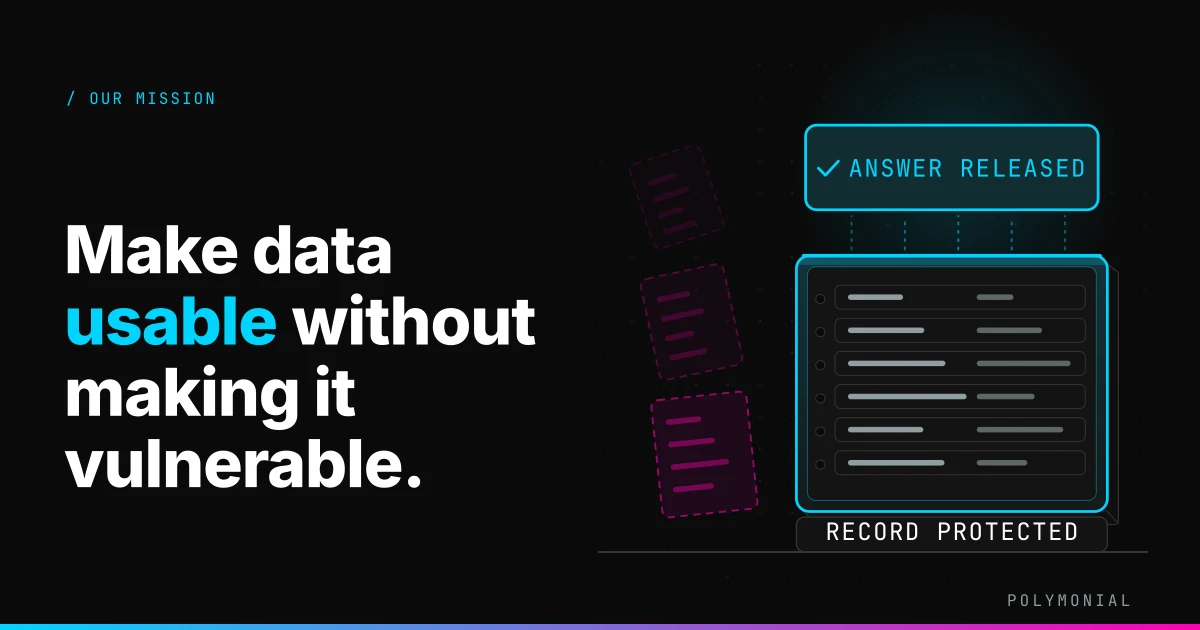
Every organisation now runs on data it has to store, move, share and put to work, across clouds, companies and borders. And almost every organisation faces the same uncomfortable trade-off: the more useful its data becomes, the more vulnerable it gets.
We started Polymonial to end that trade-off. This is our first post, so it seems right to begin with what we're here to do, and where we're going.
Our mission
Make data usable without making it vulnerable.
In practice, that means three things:
- Give every organisation the infrastructure to store, move, share and use its data with confidence. Not just the largest firms with the deepest security budgets, but every organisation whose data matters to someone else.
- Let each party receive the answer it needs, not the record behind it. Most questions need an answer. Very few need the record.
- Make it something a developer can add to what they already run, not a programme of its own. Infrastructure earns its name by fitting under what exists, not by replacing it.
Our vision
A world where trust is built into the data itself.
In that world, data moves freely between organisations, sectors and borders, smaller, protected and carrying its own rules wherever it goes. Collaboration stops being a legal negotiation and becomes a default.
Just as secure connections became invisible plumbing for every website, we believe protected, governed data will become invisible plumbing for every organisation. Nobody thinks about the padlock in their browser any more. One day, nobody will think twice about sharing data safely either. Smart Data Infrastructure is that plumbing.
Every sector, the same gap
Look across any sector and you find the same problem in a different shape. To use data together, organisations hand over far more of it than the task needs, then they lose control and visibility of the data.
- A tax authority can't reconcile filings without each party seeing the underlying records.
- A bank can't run checks on a customer without each counterparty seeing that customer's records.
- An insurer can't price a telematics policy fairly without learning where a driver went and when.
- A trial sponsor can't share outcomes with investigators and regulators without each of them accessing patient records.
- A government agency can't confirm a citizen's eligibility without seeing their full record.
- An AI developer can't show a model was trained on licensed data without exposing the whole training set.
Different shape. Same problem. Today, you share everything to answer anything.
Before and after: a smart meter and a bill
An energy supplier needs to bill a household accurately and help balance the grid at peak times.
Before. To do either, the supplier collects detailed readings from the household's smart meter throughout the day. Those readings say far more than the bill needs: when the household wakes, when it goes to bed, when it's empty, when someone is working from home. The supplier stores that detail, protects it, answers data requests about it, and carries the risk of holding a record of how a family lives.
After. The supplier still gets exactly what it needs: the right amount to bill, and a clear signal about how the household can help at peak times. It doesn't get the pattern of the household's day, because it never needed it. The household's data stays under the household's control, and the supplier holds less, protects less and worries less.
Before and after: a drive to work
The same is true on the road. A driver's insurer prices the policy on how they drive.
Before. A telematics insurer collects every journey. It knows the driver stopped for a coffee on the way to work, and called on their gran after football. It holds a record of where they go and when, and carries the risk of holding it.
After. The insurer gets the answers it prices on: did they drive safely, within the speed limit, within their curfew? It never sees where they went. Their journeys stay under their control.
That's the whole idea in miniature. Share the answer. Keep the record.
Why now
Four forces are opening a window that hasn't existed before:
- Sovereignty. Governments, customers and boards want control over where data lives, who can use it and which borders it crosses.
- Quantum. Data taken today may be readable tomorrow, so protection for data and compute has to keep pace with evolving threats.
- Regulation. Rules keep multiplying, and every new one asks for more evidence, more often.
- AI. AI is moving into everything, running on data organisations are responsible for, and it needs proof of how that data is used.
All four land on your data and compute. Each one makes the old model, where data has to be copied to be trusted, more expensive and riskier. Together, they make a new layer necessary: Smart Data Infrastructure is the layer under them.
Every era gets the infrastructure it needs
New infrastructure rarely looks important when it arrives.
- 1976, shared secrets: two strangers could agree on a secret without ever meeting. Few people outside the field saw what it would become. Today every secure connection depends on it.
- 1989, the web: a document layer for the entire planet. It became the fabric of commerce and public life.
- 1995, the secure web: protection on top of any connection. Every login and every payment now relies on its descendants.
- 2007, the smartphone: a computer in your pocket, connected everywhere. It became the computer most people use every day.
- 2008, money without a central authority: it went on to shape how independent parties check each other's records.
Each of those shifts made one layer universal. The next layer is the data itself: smaller, protected, and usable by the parties who need it without being handed to all of them. That's the infrastructure we build.
How we work
We hold ourselves to three principles.
Infrastructure, not point tools. One layer under storage, transfer, sharing and compute, so every application above it inherits the same protections instead of rebuilding them.
Built in, not bolted on. It is built to run inside your own systems, so your data doesn't have to leave to be protected.
Honest about what is proven. We show what we can prove. Where a result is still being tested, we say so. You'll see that principle in everything we publish here.
What comes next
Over the coming weeks, this blog will cover the forces reshaping how organisations use data, the regulations and programmes arriving in every sector, and what Smart Data Infrastructure changes for the people who run them.
If you want to build on it, join the waitlist for early access.
Related Posts
What is Smart Data Infrastructure?
Smart Data Infrastructure keeps your data secure, trusted and under your control, so you can share it, store it and use it without losing hold of it.
Read More ›
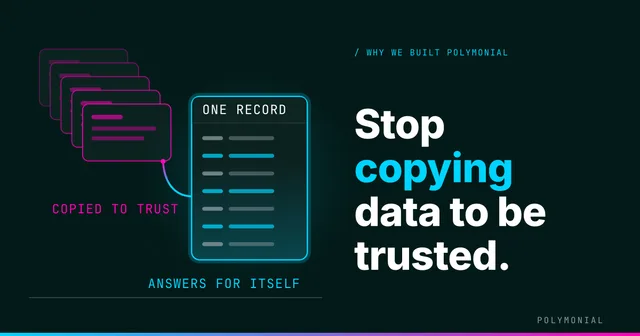
Why we built Polymonial: data trusted without copies
For decades, data has had to be copied to be trusted. We built Polymonial so that data can answer for itself, wherever it goes.
Read More ›
Trust that travels.
Secure, trusted and under your control.