Why we built Polymonial: data trusted without copies
For decades, data has had to be copied to be trusted. We built Polymonial so that data can answer for itself, wherever it goes.
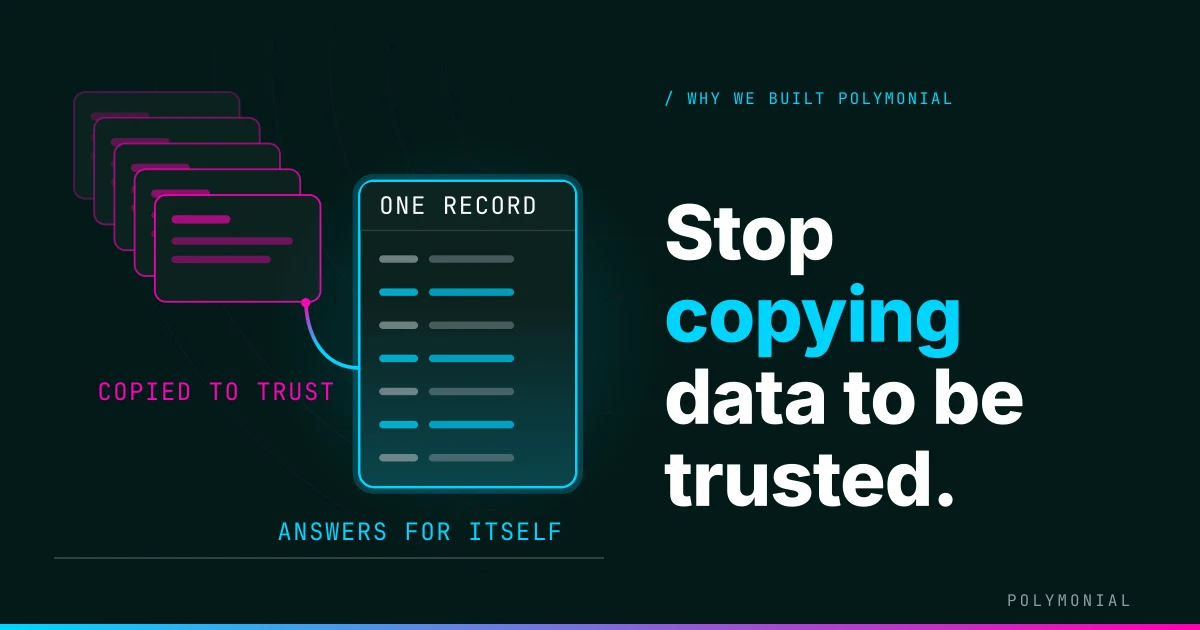
Polymonial exists because the same problem kept showing up across regulated industries, in one workflow after another.
This is the story of that problem, and why we decided it was time to solve it properly.
The same pattern, every time
In every regulated workflow, trust worked the same way. To be trusted, data had to be copied.
The regulator got a copy. The auditor got a copy. The partner, the supplier and the insurer each got a copy. Every copy was a new place to protect, a new contract to manage, and a new chance for the record to drift from the truth.
Everyone accepted this as the cost of doing business. Organisations over-shared to prove they were compliant, then spent fortunes protecting what they'd shared. Regulators collected data they didn't want, and became custodians of records they never needed to hold.
It wasn't anyone's fault. It was simply how trust worked, because trust lived in systems, and the only way to let someone check your data was to let them hold it.
What it looks like: a quarterly return
Here is the kind of moment that kept recurring, in sector after sector. (Illustrative.)
Before. A regulated firm owes its supervisor a quarterly return. A team spends two weeks extracting figures from a dozen systems, reconciling them in spreadsheets and copying the supporting records into a secure portal. The supervisor's analysts download the records, reconcile them again and file them away. Both sides now hold the same sensitive data. Both spend money protecting it. Neither can be completely sure the figures still match the systems they came from, because the copies started drifting the moment they were made. Three months later, the whole cycle starts again.
After. The supervisor asks its questions: are these figures within the limits, do these records meet the rules? The firm answers them directly. The supervisor checks the answers without taking a copy of the underlying records. Nothing drifts, because nothing was copied. The firm's team spends that time running the business. The supervisor spends its time on the firms that actually need attention.
That second picture is what we set out to make ordinary.
What building for regulated sectors taught us
Building software for regulated sectors teaches you a few things the hard way.
The first is that rules arrive slowly, then all at once. A principle appears in a consultation paper, sits quietly for years, then turns into a procurement requirement almost overnight. By the time it does, the organisations that waited are rebuilding under pressure.
The second is that every new rule tends to ask the same underlying question in different words. Show us the data is what you say it is. Show us who had access. Show us it hasn't changed. Show us you only used it as permitted. The details differ; the question doesn't.
The third is that the cost of answering that question falls on the same people every time: the teams who gather evidence, reconcile spreadsheets and copy records into portals, quarter after quarter. Their work is careful and necessary, and almost none of it would be needed if the data could speak for itself.
The question every regulator asks
Different regulators write different rules. Over time, though, they converge on one question: can the data answer for itself?
Can a supplier show its emissions are what it says, without handing over its books? Can a bank show its AI used customer data only as permitted? Can a hospital share what a study needs, and nothing more? Can a manufacturer show where every component came from?
Most systems can't answer that question, because trust lives in the systems around the data, not in the data. When data moves, trust stays behind.
What we set out to build
We built Polymonial so that trust travels with the data.
With Smart Data Infrastructure, data stays secure, trusted and under its owner's control wherever it goes. The other party gets the answer it needs, a yes, a no or a range, and checks it. The record stays where it belongs.
We set ourselves a few rules along the way:
- Start from the data, not the system. If trust lives in the data, it doesn't matter which cloud, region or partner holds it.
- Answers, not records. Most questions need an answer. Very few need the record.
- Ready for what's coming. Protection has to outlast the threats of today, and be easy to keep current.
- Fit the world as it is. Organisations shouldn't have to rebuild everything to get the benefit.
Why now
For a long time, copying data to be trusted was expensive but tolerable. That's changing quickly. Four forces are now arriving at once: Sovereignty, Quantum, Regulation and AI. All four land on an organisation's data and compute, and each one makes the old pattern more expensive, and riskier.
Sovereignty means every copy raises a question about who controls it. Quantum means every copy kept for years is a liability that grows. Regulation means every copy must be accounted for. AI means every copy might end up somewhere it shouldn't, and every piece of evidence is easier to fake.
The organisations that thrive will be the ones whose data proves itself. That's who we build for.
Who we build for
We build for organisations that hold data other people need to trust: banks and insurers, hospitals and research programmes, government departments, utilities, manufacturers and the supply chains around them. We also want to work with the partners who serve them, the integrators, consultancies, regulators and programme bodies who set and deliver the standards.
If you have ever copied data just to be believed, we built Polymonial for you. Join the waitlist for early access.
Related Posts
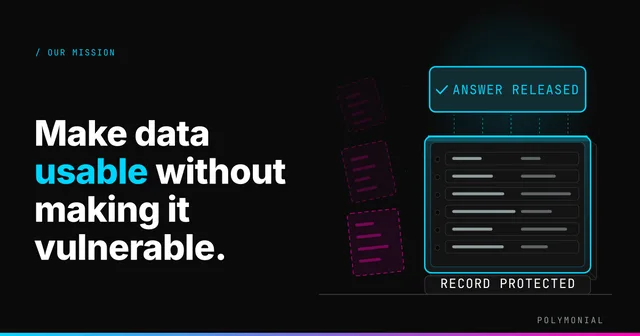
Our mission: make data usable without making it vulnerable
We exist to give every organisation the infrastructure to store, move, share and use its data with confidence, wherever it goes.
Read More ›
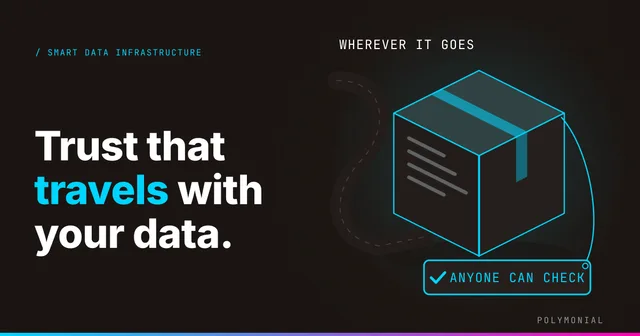
What is Smart Data Infrastructure?
Smart Data Infrastructure keeps your data secure, trusted and under your control, so you can share it, store it and use it without losing hold of it.
Read More ›
Trust that travels.
Secure, trusted and under your control.