What is Smart Data Infrastructure?
Smart Data Infrastructure keeps your data secure, trusted and under your control, so you can share it, store it and use it without losing hold of it.
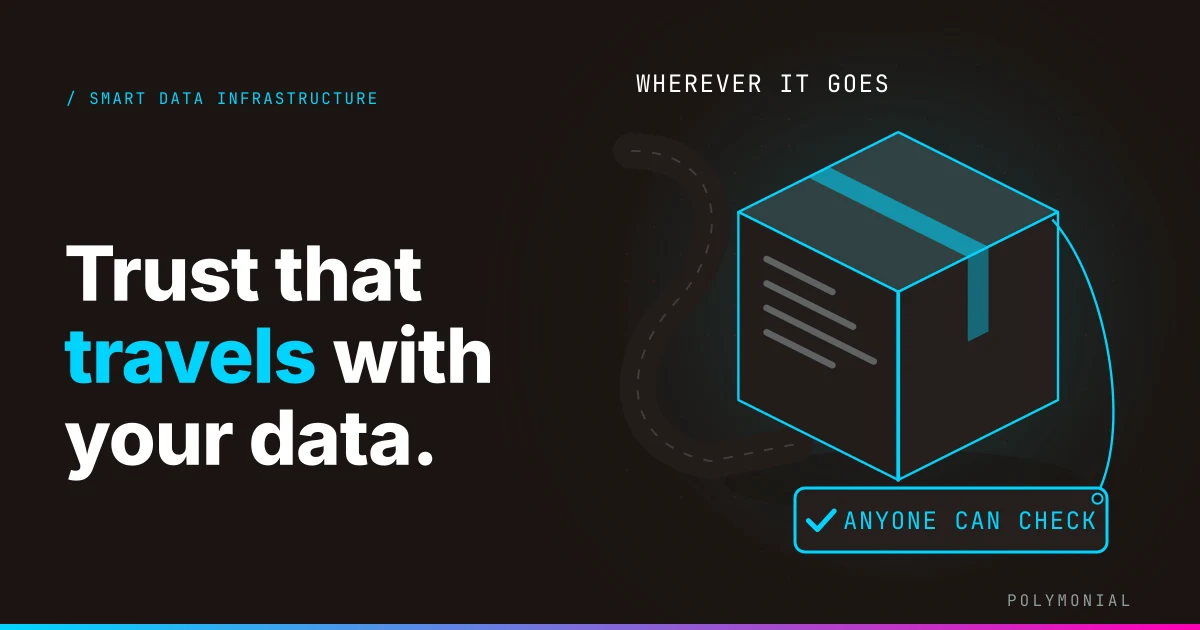
Every organisation runs on data it doesn't fully control.
Inside your own walls, you know where a record lives, who can open it and what has happened to it. The moment it leaves, to a partner, a supplier, a regulator, a cloud or an AI model, that certainty goes with it. You can no longer say who holds the record, what they do with it, or whether it is still the record you sent.
For decades the answer has been more copies, more contracts and more questionnaires. Each copy is another place to protect. Each contract is a promise, not a control. Each questionnaire asks people to describe what they cannot show.
Smart Data Infrastructure changes where trust lives.
Trust that lives in the data
Today, trust lives in the systems around your data: the network, the database, the cloud account, the vendor's policies. When the data moves, it leaves that trust behind and has to rely on whoever holds it next.
Smart Data Infrastructure puts the protection, the rules and the evidence into the data itself. Wherever the data goes, they go too. The result is data that stays secure, trusted and under your control, whoever is holding it.
Secure. Your data stays protected wherever it is stored or sent, inside your walls and outside them. A copy that ends up in the wrong hands stays protected.
Trusted. Anyone who receives it can check it for themselves. They don't have to take your word for it, and you don't have to take theirs.
Under your control. You decide who can open it and what each party gets to see. Each party sees only its share, and the rest stays yours.
Before and after: a supplier answers an auditor
A mid-sized logistics firm supplies a large retailer. Each year, the retailer's auditor asks the same question: does this supplier handle customer data to the standard the contract requires?
Before. The supplier's compliance lead spends three weeks gathering evidence. Policies are exported. Screenshots are taken. A sample of customer records is copied into a spreadsheet so the auditor can check it. The spreadsheet is emailed, forwarded and stored on at least four laptops. The auditor reads a description of the controls and accepts it, because there is no way to check it. Next year, everyone does it again.
After. The auditor asks the same question, and the supplier answers it directly. The auditor checks the answer, a clear yes against each requirement, without receiving a single customer record. Nothing is copied. Nothing is forwarded. The evidence is the same evidence the supplier relies on every day, so it doesn't drift between audits. The supplier's compliance lead spends the three weeks on something else.
Nothing about the relationship changed. What changed is that the supplier's data could answer for itself.
Share the answer, not the record
Most of the time, the other party doesn't need your data. They need an answer. Is this customer over eighteen? Does this supplier meet the standard? Is this figure within the limit? Did this shipment stay within its temperature range?
Smart Data Infrastructure lets you give them that answer, a yes, a no or a range, and keep the record. They check the answer. You keep the data.
The result is fewer copies of sensitive data, fewer questionnaires, and a clearer answer when someone asks.
Where it fits
Smart Data Infrastructure isn't a single product for a single problem. It's the layer underneath the moments where data leaves your control:
- Sharing across companies: partners, suppliers and regulators get the answer they need, not the file.
- Regulated industries: health, finance and the public sector work with sensitive records under the rules that govern them, with the controls built into the data.
- Sovereign data: control stays with the data across clouds, regions and partners, without rebuilding for every border.
- Long-lived records: data that must stay private for decades can move to stronger protection as threats change.
- AI: you can show how your AI uses data, and anyone can check that evidence hasn't been altered, even as AI makes fakes easier.
- Edge and devices: data from machines you don't physically control arrives in a state you can rely on.
Why now
Four forces are converging on every organisation that holds data worth protecting:
- Sovereignty: you must show who controls your data and where it is processed.
- Quantum: data taken today can be read later, so protection has to keep pace.
- Regulation: every new rule asks for more evidence, more often.
- AI: AI runs on the data you govern, and makes evidence easier to fake.
All four land on your data and compute. Each one raises the cost of the old model, where data has to be copied to be trusted. Smart Data Infrastructure is the layer under all four, and turns each one from a cost into something you can prove.
What changes for your teams
Security teams stop defending every copy, because there are fewer copies, and the ones that exist carry their own protection.
Compliance teams stop assembling evidence by hand, because the evidence lives with the data and can be checked by whoever needs it.
Data teams can say yes to sharing more often, because sharing no longer means giving the data away.
Leaders get a straight answer to the question every board now asks: where is our data, who controls it, and can we prove it?
The shift
Your data no longer has to stay at home to stay safe. With Smart Data Infrastructure, it goes where your business needs it, and stays secure, trusted and under your control when it gets there.
See what Smart Data Infrastructure does for your data. Join the waitlist for early access.
Related Posts
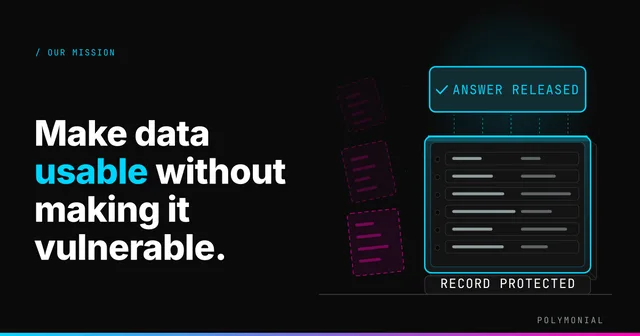
Our mission: make data usable without making it vulnerable
We exist to give every organisation the infrastructure to store, move, share and use its data with confidence, wherever it goes.
Read More ›
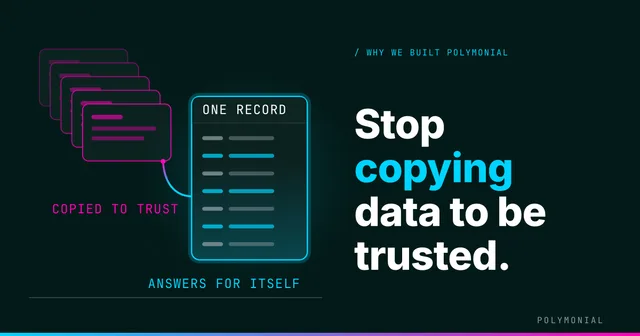
Why we built Polymonial: data trusted without copies
For decades, data has had to be copied to be trusted. We built Polymonial so that data can answer for itself, wherever it goes.
Read More ›
Trust that travels.
Secure, trusted and under your control.