CRA reporting: a checklist for manufacturers
Cyber Resilience Act reporting has applied to manufacturers since September 2026. Use this checklist to be ready before your next report.
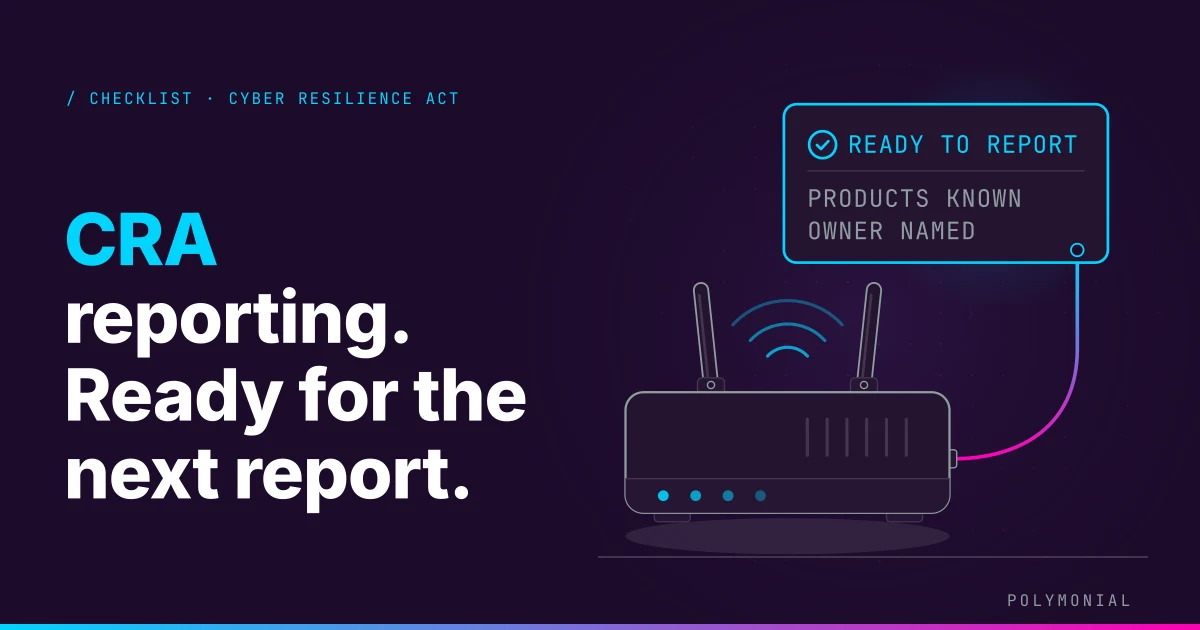
Since September 2026, manufacturers of products with digital elements sold in the EU must report actively exploited vulnerabilities and severe incidents under the Cyber Resilience Act, including for products already on the market. From December 2027, the main obligations follow for products placed on the market from then on, and for older ones when they are substantially modified: secure-by-design requirements, vulnerability handling and conformity.
The reporting duty falls on manufacturers. Sector operators report under their own rules, such as NIS2 and DORA. Reports have to be prompt, and they have to be right. This checklist helps you be ready before the next one is due.
Know what you make
- Every product in scope is listed, including older products still on the market and still receiving updates.
- Every component is known, including third-party and open-source parts, so you can tell quickly whether a new vulnerability affects you.
- Every version in the field is known, so you can say which customers are exposed.
Know who decides
- Each report has a named owner, with a deputy, and the authority to send it.
- The threshold is agreed in advance. Decide what counts as actively exploited or severe before an incident, not during one.
- Suppliers' duties are written down, so a component maker tells you promptly when its part is affected.
Know what you'll say
- Reports are drafted from records, not memory: what happened, when it was found, what was affected and what was done.
- Those records can be relied on. If they could have been quietly edited afterwards, an authority has no reason to trust them, and neither do you.
- Follow-up reports build on the first, so the account stays consistent from first notice to final report.
Know who receives it
- Reports reach only the authorities entitled to them. Details of an unfixed vulnerability are valuable to attackers.
- Customers get what they need to protect themselves, without exposing anyone else.
Keep products trustworthy
- Customers can trust that updates are genuine. A fix only helps if customers can be sure it came from you, unaltered.
- Product security keeps pace with standards as they change through to December 2027 and beyond, including the move to post-quantum protection.
Rehearse
- Run a practice report against a realistic incident, end to end, and time it.
- Fix what slowed you down, then run it again.
Where Smart Data Infrastructure fits
With Smart Data Infrastructure, the records behind each report stay secure, trusted and under your control. Customers can check that updates and products are genuine. Reports go to the authorities the law names, and customers hear what they need to act on. And you can strengthen product security as standards change, without starting again.
Reporting is live now, and the next exploited vulnerability won't wait for your process to be ready. Talk to us about your Cyber Resilience Act programme.
Related Posts
The Cyber Resilience Act: report on time, with evidence
Manufacturers selling into the EU now report exploited vulnerabilities and severe incidents, with design duties from December 2027. Answer with evidence.
Read More ›

DORA in practice: answering for every technology supplier
DORA makes EU financial firms prove their resilience, including every technology supplier they rely on. The hard part is evidence that stands up.
Read More ›
Your DORA register of information: a checklist
DORA expects every EU financial firm to keep a register of its technology suppliers. Here's how to make yours one you can stand behind.
Read More ›
Trust that travels.
Secure, trusted and under your control.