Your DORA register of information: a checklist
DORA expects every EU financial firm to keep a register of its technology suppliers. Here's how to make yours one you can stand behind.
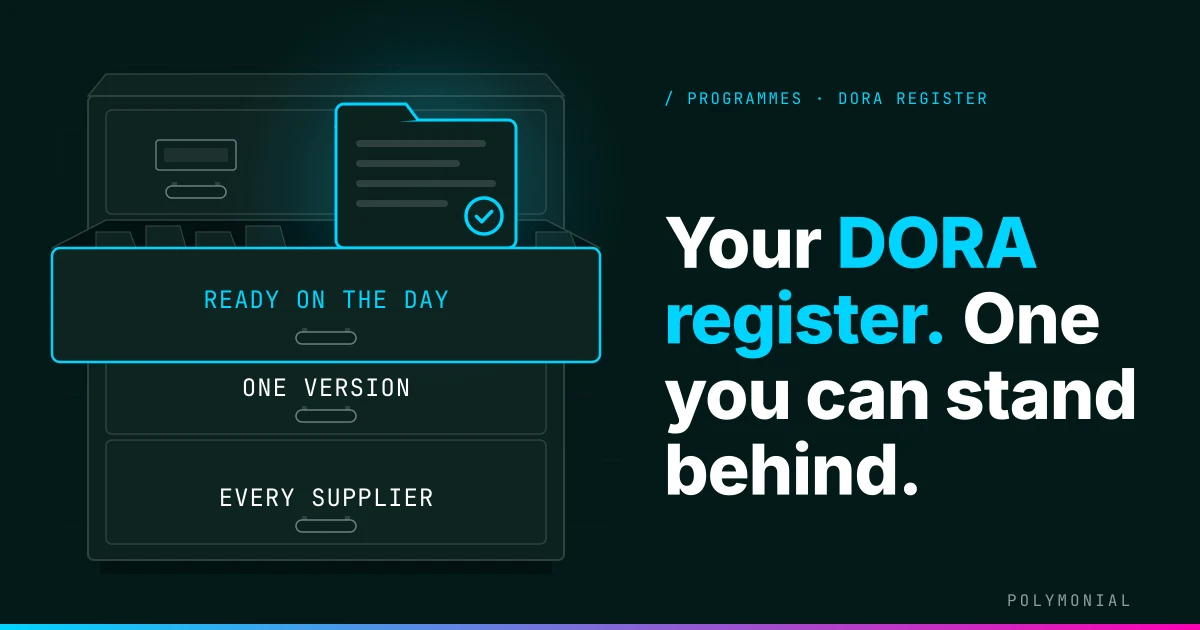
DORA, the EU's Digital Operational Resilience Act, has applied since January 2025. Among its demands, every bank, insurer and investment firm must keep a register of the technology suppliers it relies on. Supervisors use those registers to see where the sector leans on the same providers, and in November 2025 they designated the first critical technology providers, which they now oversee directly.
Most firms have a register. Fewer have one they would happily defend line by line. This checklist is for getting to the second kind.
The checklist
- Every arrangement is in it. Not just the large contracts. Subcontractors behind your main suppliers, services provided within your own group, and the small tools that quietly support an important function all count.
- Each supplier is linked to what it supports. A register earns its keep when it shows which business functions would stop if a supplier did.
- It shows where data is processed and stored. Location matters to your supervisor, and to your own view of sovereignty risk.
- There is one current version. If several copies circulate by email, nobody can say which was true on a given day.
- You can show what it said, and when. When a supervisor asks about an incident, being able to show the register as it stood at the time, not just as it stands today, makes the answer far stronger.
- Changes leave a trail. Every addition, removal and correction is recorded, with who made it, so the register can't be quietly rewritten.
- Suppliers' own information is evidenced. Where a supplier tells you about its subcontractors, locations or certifications, you hold its confirmation, not just a note of a phone call.
- You can share just what is asked. A question about one supplier shouldn't mean sending the whole register, or anything about your customers.
- It connects to incidents and testing. When a supplier is involved in an incident or a resilience test, its entry reflects that.
- Someone owns it. A named team keeps it current, and the board knows who that is.
Where registers usually fall short
Most gaps aren't missing columns. They're about trust: a spreadsheet that has drifted from reality, entries that changed without a record, and no way to show a supervisor what the register said on the day that matters.
What good looks like
With Smart Data Infrastructure, the register becomes evidence. Supplier exchanges are recorded as they happen, so the register can show what it said on any day. You share what supervisors and partners need with them and no one else, and they can check where it came from. Your suppliers, in turn, can show each client exactly what it needs to see, and no more.
If the register sits on your desk, talk to us about your DORA programme.
Related Posts
DORA in practice: answering for every technology supplier
DORA makes EU financial firms prove their resilience, including every technology supplier they rely on. The hard part is evidence that stands up.
Read More ›
Financial services KYC: verify a customer once, reuse it
Customers prove who they are once. Every bank, broker and fintech that asks afterwards gets the answer it needs, without another copy of their documents.
Read More ›
CRA reporting: a checklist for manufacturers
Cyber Resilience Act reporting has applied to manufacturers since September 2026. Use this checklist to be ready before your next report.
Read More ›
Trust that travels.
Secure, trusted and under your control.