DORA in practice: answering for every technology supplier
DORA makes EU financial firms prove their resilience, including every technology supplier they rely on. The hard part is evidence that stands up.
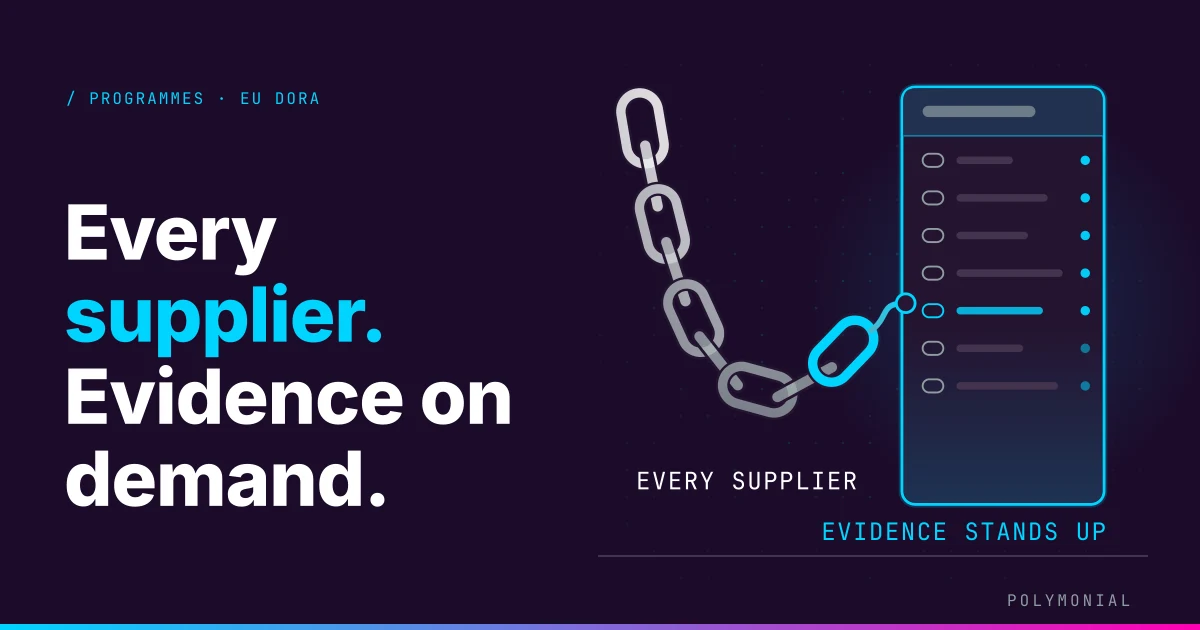
The Digital Operational Resilience Act, DORA, has applied since January 2025. It asks a simple question of banks, insurers, investment firms and most other financial firms in the EU: can you prove your operations will hold up, including everything your technology suppliers do for you?
What DORA asks for
EU financial firms must:
- manage technology risk across their own operations;
- report major incidents to their supervisor;
- keep a register of every technology supplier they depend on;
- test their digital resilience regularly, with the largest firms running threat-led tests on their critical functions.
In November 2025, the European supervisors designated the first critical technology providers, which they now oversee directly.
Why it takes years
Every supplier contract has to be mapped, classified and fixed. Resilience is tested regularly, and the largest firms run threat-led tests on their critical functions. Suppliers are drawn in too, because their clients now have to answer for the service they provide.
For most firms, DORA isn't a project with an end date. It's a way of operating.
Who it reaches
DORA applies directly to financial firms, but its weight lands across the supply chain. Cloud providers, data centres, software vendors, payment processors and managed-service firms all find their customers asking new questions: where is our data processed, who else can reach it, what happened during that outage, and can you prove it? A supplier that can answer clearly becomes easier to buy from, and easier to keep.
Before and after: a supervisor asks about an outage
An insurer's claims platform went down for most of a working day after a problem at one of its software suppliers. Its supervisor asks for the facts: when the insurer knew, what the supplier did, which services were affected, and how the insurer's register of suppliers reflects the arrangement.
Before. The operational-risk team pieces the timeline together from email threads, chat messages and the supplier's own incident report, which arrived a week later and doesn't quite match the insurer's notes. The register of suppliers is a spreadsheet with several versions in circulation, and nobody is sure which one was current on the day. To be safe, the insurer sends the supervisor a large bundle of documents, including far more about its suppliers and customers than was asked for. Answering takes weeks, and the answer still contains gaps.
After. The insurer and its supplier both work from the same records of their exchanges, kept as they happened. The timeline is already there, and both sides agree on it because both rely on the same evidence. The register shows exactly what it said on the day of the outage. The insurer shares what the supervisor asked for, secure for the supervisor alone, and nothing more. The answer is quick, complete and consistent with the supplier's account.
Where evidence breaks down
Registers live in spreadsheets that drift from reality. Supplier exchanges are recorded in systems that can be quietly changed. Sharing what a supervisor needs often means sending far more than they asked for.
When the supervisor asks, the answer has to be evidence, not a description.
What good looks like
With Smart Data Infrastructure:
- Share what supervisors and partners need with them and no one else, and they can check where it came from.
- Keep records of every supplier exchange made as it happens and shared with both sides.
- Move to stronger protection at your own pace, alongside what you already run.
For technology suppliers, the same evidence works in their favour. They can show each client, and each client's regulator, exactly what they need to see, and no more.
What changes for your teams
Operational-risk teams stop rebuilding timelines from email threads, because the record of what happened already exists and both sides rely on it.
Procurement and vendor-management teams keep a register that shows what it said on any given day, rather than a spreadsheet nobody fully trusts.
Compliance teams answer supervisors with what was asked for, rather than sending everything to be safe.
Suppliers' account teams spend less time answering the same resilience questionnaire from every client, because their evidence can be shared directly and checked.
The pressure, from both sides
DORA puts financial firms and their suppliers on the same side of the table. Both need to show their controls work, and both are better off when they rely on the same evidence rather than competing accounts of what happened.
Whether you're a financial firm mapping your suppliers or a supplier answering your clients, talk to us about your DORA programme.
Related Posts
Financial services KYC: verify a customer once, reuse it
Customers prove who they are once. Every bank, broker and fintech that asks afterwards gets the answer it needs, without another copy of their documents.
Read More ›
The perfect storm: four forces converging on your business
Sovereignty, Quantum, Regulation and AI are arriving at once. Each raises the cost of holding data, and each can become value when your data proves itself.
Read More ›
Your DORA register of information: a checklist
DORA expects every EU financial firm to keep a register of its technology suppliers. Here's how to make yours one you can stand behind.
Read More ›
Trust that travels.
Secure, trusted and under your control.