Healthcare: hospital insight without moving records
Research needs answers from many hospitals, and patients need their records to stay put. A study receives what it needs, and nothing more.
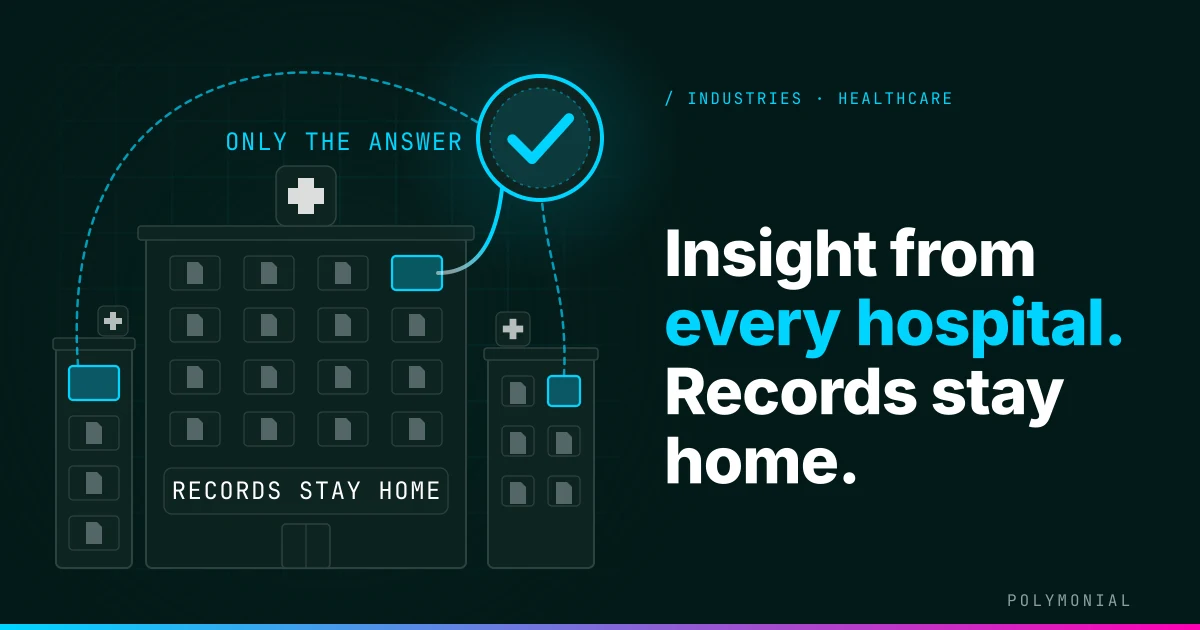
Some of medicine's most important questions can't be answered by one hospital alone. A rare condition might appear a handful of times a year in any single trust. A treatment's long-term effect only shows up across thousands of patients. A new diagnostic tool needs to be tested on populations that look like the people it will serve.
The answers sit in records spread across many organisations. And those records are among the most sensitive data anyone holds.
So research has always faced the same trade-off. Either the records move, with all the agreements, extracts, copies and risk that brings, or the question goes unanswered.
Before and after: a study across several hospitals
A research team wants to understand how patients with a rare condition respond to two treatments. They need data from several hospitals. (Illustrative.)
Before. Each hospital negotiates its own data-sharing agreement. Information-governance teams review the request line by line. Analysts build an extract, strip out what they can, and send a copy to a central research environment. Months pass before the first analysis runs. When it does, the study holds patient-level data from every site, which it must secure, audit and eventually destroy. If a hospital's governance board says no, that hospital's patients simply aren't counted.
After. The study asks each hospital the questions it needs answered. Each hospital checks the request against its own rules and answers it. The records never leave the hospital. The research team receives the answers it was entitled to, and can check that each one came from the hospital it says it did. Governance teams approve a question, not an extract. The analysis starts sooner, and every hospital that takes part can be counted.
What changes for hospitals
- Records stay home. Patient data stays inside the organisation that is responsible for it, under the controls it already runs.
- Approve the question, not the copy. Governance teams decide what may be asked and answered, rather than reviewing bulk extracts.
- A record of every answer. Each hospital can show what it shared, with whom, and why.
- Taking part gets easier. Smaller trusts with limited analyst time can contribute without building a bespoke extract for every study.
What changes for researchers
Studies can start sooner, because one of the slowest steps, moving the data, falls away. Sample sizes can grow, because hospitals that couldn't justify releasing records can still answer questions. Results are easier to defend, because every input can be traced back to where it came from.
What changes for patients
Their records aren't copied into one more database for each study that wants to learn from them. They gain from research that includes people like them, without their details travelling further than they need to. Their data stays secure, trusted and under the control of the organisations they gave it to.
Beyond research
The same pattern runs through healthcare wherever one organisation needs to know something another holds.
- Referrals and transfers of care. A receiving team needs the facts that matter for the next step, not the whole history.
- Commissioning and planning. A health system needs to know how services perform across providers, without pooling every patient record.
- Clinical trials. Sponsors need trial data to meet the rules on quality and transparency, with a clear account of where every figure came from.
- Medical AI. A model needs to be tested against data from the people it will serve, and its developer needs to show how that data was used.
In each case, sharing the answer instead of the record lowers the risk and can shorten the wait.
The pressures behind it
The four forces reshaping every organisation land squarely on health data, and all four land on your data and compute. Regulation is opening up secondary use: under the European Health Data Space, secondary-use rules begin for most data by March 2029. Sovereignty rules shape where patient data may be processed. Records kept for a lifetime need protection that lasts as long as they do. And AI is moving into diagnosis and triage, where it has to show how it used the data it learned from.
Smart Data Infrastructure is the layer under all four: data that stays with its owner, and answers that can be trusted wherever they go.
If your organisation holds, shares or studies health data, talk to us about your sector.
Related Posts
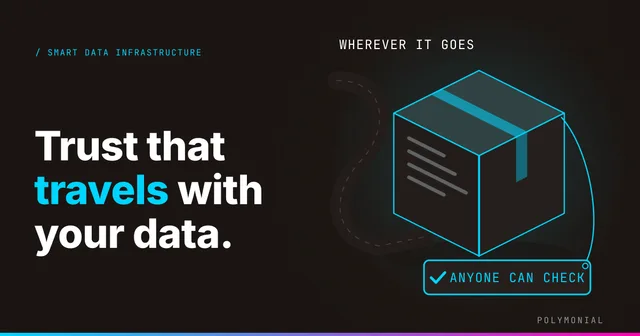
What is Smart Data Infrastructure?
Smart Data Infrastructure keeps your data secure, trusted and under your control, so you can share it, store it and use it without losing hold of it.
Read More ›
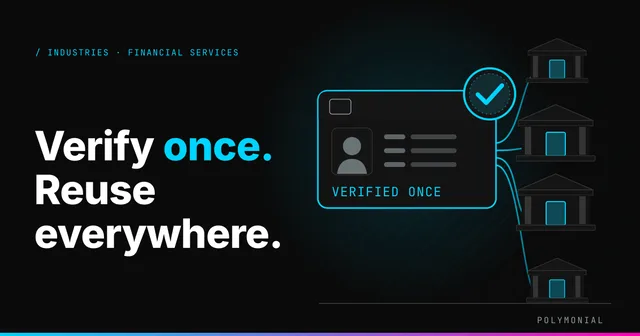
Financial services KYC: verify a customer once, reuse it
Customers prove who they are once. Every bank, broker and fintech that asks afterwards gets the answer it needs, without another copy of their documents.
Read More ›
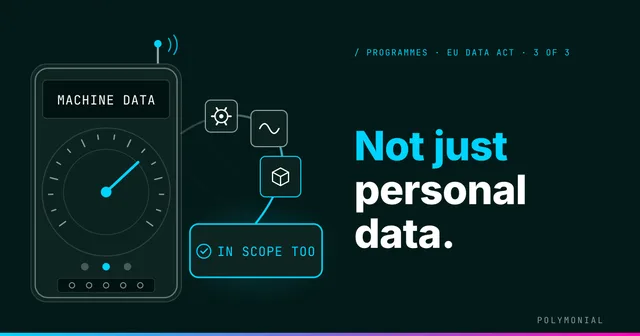
It covers non-personal data too
The EU Data Act isn't only about personal data. Machine, product and operational data are in scope too, and many organisations haven't noticed.
Read More ›
Trust that travels.
Secure, trusted and under your control.