EU AI Act dates: what applies when, and the evidence needed
The EU AI Act applies in stages, with high-risk AI due from December 2027. Each stage asks for evidence of how your AI is governed.
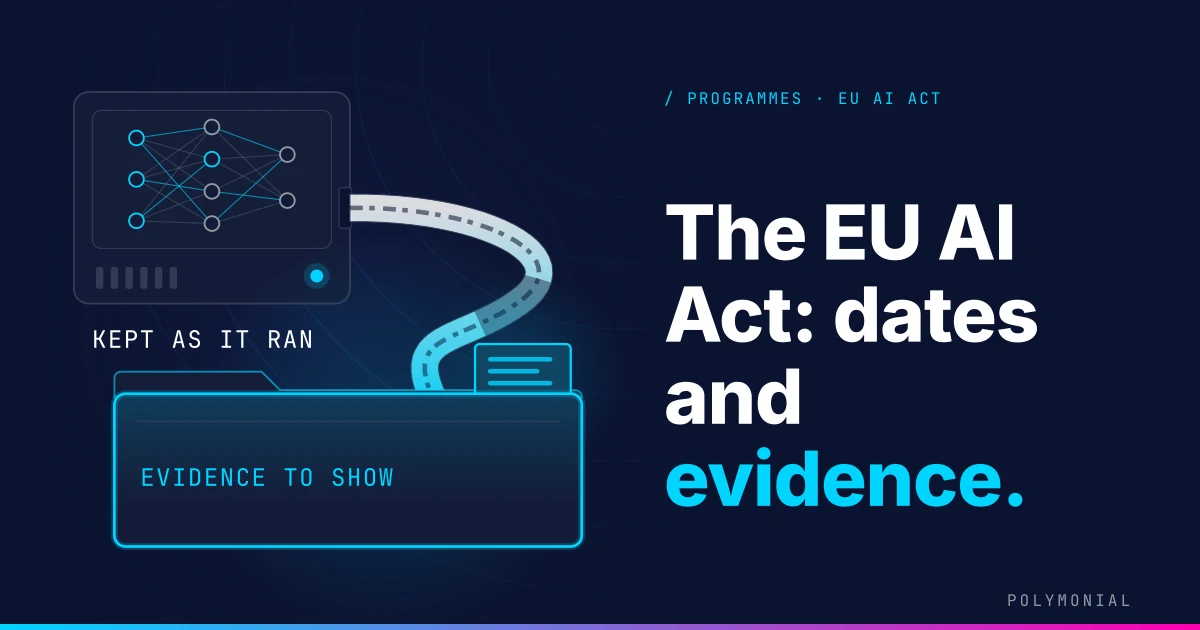
The EU AI Act sets rules for AI according to the risk it carries. It doesn't arrive all at once. Each stage brings a new set of obligations, and each one comes down to the same thing: showing, with evidence, how your AI is governed.
The dates that matter
- February 2025: the prohibited AI practices apply.
- August 2025: obligations for general-purpose AI models apply.
- August 2026: the transparency obligations apply, so people must know when they are dealing with AI or AI-generated content.
- December 2027: stand-alone high-risk AI systems must comply.
- August 2028: high-risk AI built into regulated products must comply.
The high-risk dates moved in 2026. The Digital Omnibus on AI, in force since July 2026, pushed them back to give firms and standards bodies more time to prepare.
Who is affected
The Act reaches far beyond technology companies. High-risk uses include AI that helps decide who gets credit, who gets a job interview, who receives a public benefit, or how a patient is triaged. Banks, insurers, employers, public bodies and healthcare providers all run systems that may fall into these categories, whether they built the AI themselves or bought it from a supplier.
If you deploy high-risk AI, you carry obligations even when someone else built the model.
What the high-risk rules ask for
Organisations running high-risk AI have to show that:
- the data used to train and run the system is governed and fit for purpose;
- the system keeps records of what it does, and those records can be relied on;
- people can oversee it, and step in when they need to;
- its documentation is complete and current.
Guidance and standards are still arriving, and the work happens system by system. Firms move one AI system at a time, not in a single step.
Before and after: a supervisor asks about a credit model
A lender uses an AI model to help decide which loan applications go forward. Its supervisor asks a straightforward question: over the last quarter, what data did the model use, and were the lender's own rules followed every time? (Illustrative.)
Before. The question lands with the data science team, who pass it to engineering, who pass it to the platform team. Logs are pulled from three systems. Some have been rotated away. Training data lineage lives in a wiki page that was last updated before the model was retrained. A spreadsheet is assembled to show which customer fields the model could see. It takes several weeks, and the final answer comes with caveats nobody is comfortable with. The supervisor reads a description of what should have happened, and has no way to check it.
After. The lender answers from records the model kept as it ran: which data each decision used, and whether that use was permitted under the lender's rules. The supervisor can check them for itself, rather than take the lender's word. Only what the supervisor asked for is shared. The answer comes sooner, and it is the same evidence the lender's own risk team uses every month.
Why evidence is the hard part
Most organisations can describe how their AI is meant to be governed. Far fewer can show it. Logs can be edited. Spreadsheets drift from reality. Data is copied into places nobody tracks.
When a supervisor asks how an AI system used your data, a description is not an answer. Evidence is.
What good looks like
With Smart Data Infrastructure:
- You show how each AI system uses data, with records that stand up to scrutiny.
- Data reaches only the people and systems entitled to it.
- Your rules are applied consistently across every system.
The result is AI you can put in front of a regulator, a customer or a board, with the evidence to back it.
Where to start
The December 2027 date looks distant. Risk management, records and conformity take time to put in place for every high-risk system. Start with an inventory of the AI systems you run or buy, identify which ones are likely to be high-risk, and pick the one that carries the most risk. Build the evidence for that system first, then repeat.
If you run or buy AI that may be high-risk, talk to us about your AI Act programme.
Related Posts
The perfect storm: four forces converging on your business
Sovereignty, Quantum, Regulation and AI are arriving at once. Each raises the cost of holding data, and each can become value when your data proves itself.
Read More ›
What is Smart Data Infrastructure?
Smart Data Infrastructure keeps your data secure, trusted and under your control, so you can share it, store it and use it without losing hold of it.
Read More ›
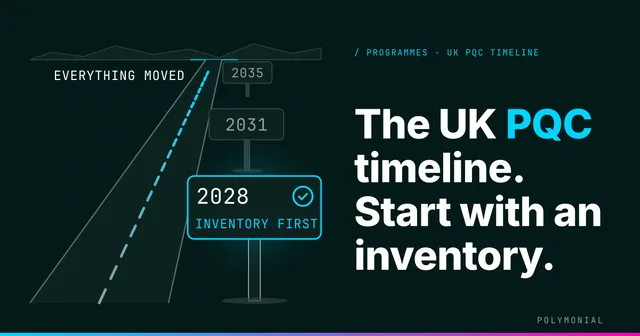
The UK PQC timeline: 2028, 2031, 2035
The NCSC sets three milestones for moving UK systems to post-quantum protection. The first, by 2028, starts with knowing what you hold.
Read More ›
Trust that travels.
Secure, trusted and under your control.