Regulation countdown: the first half of 2027
Between December 2026 and June 2027, product passports, certificate sales, machinery rules and new health milestones all arrive. What lands, and when.
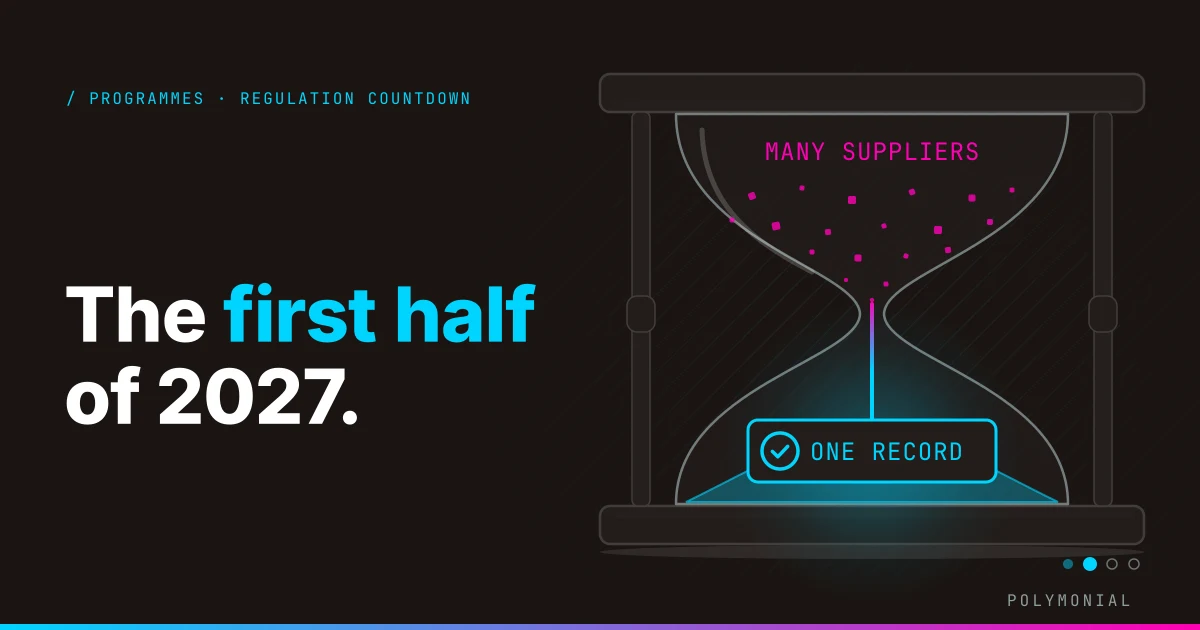
Regulation countdown, part two of four.
Last time we looked at the rules already in force. This part covers the next seven months: a run-up in December 2026, then the first half of 2027. It is a crowded stretch, and several of its dates fall on organisations that have never had to think of themselves as regulated data handlers.
The run-up: December 2026
The year ends with four dates worth knowing.
- AI-generated content. Generative systems that were already on the market before August 2026 must meet the AI Act's marking duty by December 2026.
- Product liability. Member States must transpose the EU's revised Product Liability Directive into national law by December 2026.
- Deforestation. Large operators placing cattle, cocoa, coffee, palm oil, soy, rubber or wood on the EU market must show deforestation-free origin from the end of December 2026.
- Post-quantum. Under the EU's coordinated roadmap, every Member State should have started its transition by the end of 2026.
January to March 2027
- January 2027: machinery. The EU Machinery Regulation applies to machinery placed on the EU market.
- February 2027: battery passports. A digital battery passport becomes mandatory for electric vehicle batteries, light transport batteries and industrial batteries above 2 kWh, including home storage, placed on the EU market.
- February 2027: carbon certificates. Sales of certificates under the Carbon Border Adjustment Mechanism begin.
- February 2027: NHS sign-in. NHS England removes the older smartcard sign-in from service. Every supplier and NHS organisation must have moved to the newer one.
- March 2027: European health data. Key implementing acts for the European Health Data Space fall due, setting the detail for the exchanges due in 2029.
April to June 2027
- 1 April 2027: NHS England. The government plans to move NHS England's functions into the Department of Health and Social Care, subject to Parliament.
- June 2027: deforestation, second wave. Micro and small enterprises come under the Deforestation Regulation.
One more date falls just after this stretch.
- July 2027: Swift. Swift plans to release its network upgraded for post-quantum protection, and connected institutions then have 15 months to move.
The pattern
Look at what these dates ask for and the same theme returns. Battery passports, carbon declarations and deforestation rules all need data from suppliers outside your walls, often outside the EU, assembled into a record you answer for. Machinery and product liability rules need a history of a product that stands up after something goes wrong. Health data milestones need records exchanged without losing control of them.
In each case, the evidence comes from many hands and has to hold up in front of someone who wasn't there.
Before and after: a manufacturer meets two dates at once
An equipment maker sells connected machinery that includes industrial battery packs. Its January and February 2027 dates arrive back to back. (Illustrative.)
Before. The machinery team prepares its technical file. The battery team chases cell suppliers for passport data. Both need the same product history, and each builds its own copy from emails and supplier portals. When a customer reports a fault, nobody is sure which version of the product record is current.
After. Each supplier contributes its part of the product record once, and it stays as it was contributed. The machinery file and the battery passport draw on the same record. When a fault is reported, the maker shows exactly what was supplied, by whom, and what has changed since.
What good looks like
Smart Data Infrastructure gives each of these rules the same foundation: supplier data that arrives once and stays as it was contributed, shared with each party only as far as it needs, and kept secure, trusted and under your control. The first of these dates is weeks away, and supplier data takes months to gather.
Next in the series: the second half of 2027, and the December cluster.
If any of these dates is yours, talk to us about your 2027 programme.
Related Posts
Regulation countdown: what's already live
Many of the rules reshaping how data is handled aren't future deadlines: they already apply, and supervisors want evidence now. Here's what is live.
Read More ›
EU Digital Identity Wallet: what changes for you
Every EU state must offer a digital identity wallet by the end of 2026. What changes for the people who carry it and the businesses that ask.
Read More ›
Regulation countdown: the second half of 2027
The second half of 2027 ends in a cluster: high-risk AI, the Cyber Resilience Act and the Forced Labour Ban all land in December. What arrives, and when.
Read More ›
Trust that travels.
Secure, trusted and under your control.