Ralph Merkle: Merkle's puzzles and Merkle trees
Ralph Merkle showed that strangers could build a secret in the open, and that one short summary could stand guard over a vast record.
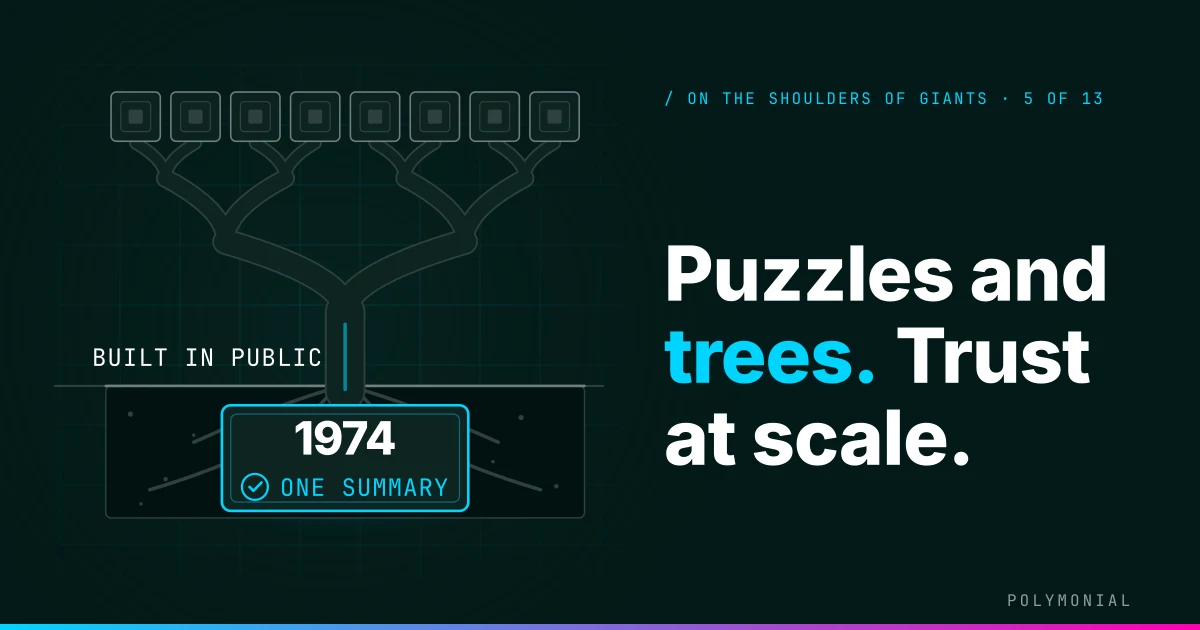
On the shoulders of giants, part five of thirteen.
In the autumn of 1974, Ralph Merkle was an undergraduate taking a computer security course at the University of California, Berkeley. Students were asked to propose a project. Merkle proposed something most people at the time thought couldn't be done: two people who had never met, with no secret in common, talking only over a channel anyone could listen to, ending up with a secret the listener didn't know.
The idea was unfamiliar enough that it struggled to find a home. His course proposal was turned down, and his paper took until 1978 to reach print.
The puzzles
Merkle's idea is easiest to picture as a box of puzzles. One person sends the other a great many puzzles, openly, each hiding a secret and each solvable with modest effort. The other solves just one, chosen at random, and says which one without revealing what was inside. Both now share that puzzle's secret. A listener, not knowing which puzzle was chosen, faces far more work than either of them.
The margin is modest by today's standards, and Merkle's puzzles were never the method the world adopted. What mattered was the demonstration: a shared secret could be built in public, from nothing, with the listener left behind. In 1976, before Merkle's paper appeared, Whitfield Diffie and Martin Hellman at Stanford published a far stronger way of doing the same thing. Hellman later suggested that the work deserved to carry Merkle's name alongside theirs.
The trees
Merkle's second idea, from his doctoral work at Stanford in 1979, answers a different question: how can you check that a huge collection of records hasn't changed, without looking at all of it?
Start by taking a short fingerprint of each record: a small summary that changes completely if even one character of the record changes. Pair the fingerprints up and take a fingerprint of each pair. Pair those up and do it again. Keep going until a single fingerprint sits at the top.
That top fingerprint stands for everything beneath it. Change any record, anywhere, and it changes. To show that one particular record belongs to the collection, you don't hand over the whole collection. You need only the record and the handful of fingerprints along its path to the top. Even for an enormous collection, that path is short.
This shape became known as a Merkle tree.
Why it lasted
The tree solved a problem that has grown with every year of computing: more data, held in more places, by more people who don't fully trust each other.
Today the same shape helps devices check that their software hasn't been altered, lets version-control systems tell at a glance whether two copies of a project match, keeps file-sharing networks honest about the pieces they pass around, and underpins public logs of the certificates websites use to identify themselves. Each use rests on Merkle's observation: one short summary can stand for a vast record, and anyone can check a small part of it against that summary.
Two ideas, one theme
The puzzles and the trees share a theme. Both are about trust between parties who can't simply rely on each other. The puzzles showed that a secret could be agreed without a prior meeting. The trees showed that integrity could be checked at scale, a piece at a time, by anyone holding the summary.
Those two ideas, trust without a meeting and integrity at scale, run through almost every system that now keeps data secure, trusted and under the control of the people it belongs to.
Next in the series: Diffie and Hellman, and how two strangers can agree a secret in public.
Join the waitlist for early access.
Related Posts
Kerckhoffs's principle (1883): the secret is the key
In 1883 Auguste Kerckhoffs argued that a cipher should stay safe even if the enemy knows how it works. It still shapes how security is judged.
Read More ›
Claude Shannon (1949): what perfect secrecy means
In 1949 Claude Shannon defined perfect secrecy and showed when it is possible. For the first time, secrecy could be measured, not just claimed.
Read More ›
Alan Turing and Bletchley Park: codebreaking and computing
At Bletchley Park, Alan Turing and thousands of colleagues read enemy messages at scale. Their work helped shape the war and the computer age.
Read More ›
Trust that travels.
Secure, trusted and under your control.