Claude Shannon (1949): what perfect secrecy means
In 1949 Claude Shannon defined perfect secrecy and showed when it is possible. For the first time, secrecy could be measured, not just claimed.
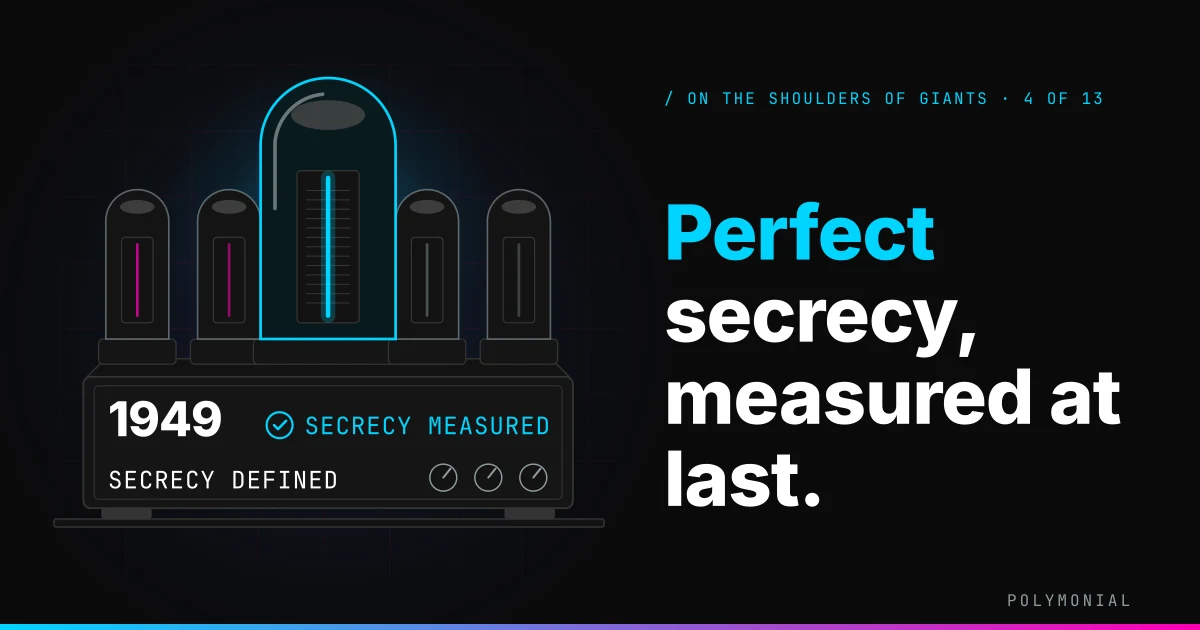
On the shoulders of giants, part four of thirteen.
By the end of the Second World War, people had been making and breaking ciphers for thousands of years. Yet nobody could say precisely what it meant for a cipher to be secure. Codebreakers judged a system by whether they could break it. Designers judged it by whether anyone had. Secrecy was a matter of experience and argument, not measurement.
In 1949, an American mathematician and engineer named Claude Shannon changed that.
The man and the moment
Shannon spent the war at Bell Labs, working among other things on ways to keep wartime communications secret. In early 1943 Alan Turing spent time at the laboratories, and the two men met and talked about machines that might one day think, though wartime secrecy kept them from comparing their codebreaking work.
In 1945 Shannon wrote a classified report on the mathematics of secrecy. A version was published openly in 1949 as "Communication Theory of Secrecy Systems". The year before, he had published "A Mathematical Theory of Communication", which founded information theory: a way of measuring information itself, in bits.
What perfect secrecy means
Shannon's definition is simple to state. A system has perfect secrecy if intercepting the scrambled message tells the enemy nothing new about the original.
Before the interception, the enemy has some idea of what the message might say. After it, they have exactly the same idea, and no better. The intercepted text could have come from any possible message, each just as likely as it was before.
That is a remarkably strong standard. It doesn't depend on how clever the enemy is, how long they work or how much computing power they have. It isn't "hard to break". There is nothing to break.
What Shannon showed
Shannon showed two things.
First, perfect secrecy is possible. The one-time pad, Vernam's cipher with Mauborgne's rules of a truly random key used only once, meets the standard exactly. What practitioners had believed for some thirty years now rested on a precise mathematical footing.
Second, perfect secrecy has a price. Any perfectly secret system needs a key at least as uncertain as the messages it protects: in practice, as much secret key as there is message. There is no clever way around it. The catch that made the one-time pad so hard to use turned out to be a law, not a flaw in one design.
Measuring secrecy
Shannon did more than define the ideal. He gave a way to describe how far real systems fall short of it. Using his measure of information, he could ask how much an enemy could learn about the key from intercepted traffic, and how much traffic they would need before only one key fitted. Below that amount, even unlimited effort can't single out the right answer. Above it, security rests on the work being too great to do.
That split, between protection that holds whatever an attacker does and protection that holds because breaking it is too much work, still organises how security is judged today. Most protection in everyday use is of the second kind. Shannon gave us the language to say so plainly.
He also described two qualities a good practical cipher should have, which he called confusion and diffusion. Each part of the output should depend on the key in complicated ways, and each part of the message should influence much of the output. Those ideas still guide how practical ciphers are designed.
And he restated Kerckhoffs' principle as a working assumption: "the enemy knows the system being used".
Why it still matters
Shannon gave secrecy what engineering had long had: a definition and a measure. Claims about security could now be checked against a standard rather than accepted on reputation.
When a product describes data as "secure" today, Shannon's questions still apply. Secure against what? Measured how? Resting on which assumptions? A claim that can answer all three is worth far more than one that can't.
Next in the series: Merkle, his puzzles and his trees, and trust without a meeting.
Join the waitlist for early access.
Related Posts
Kerckhoffs's principle (1883): the secret is the key
In 1883 Auguste Kerckhoffs argued that a cipher should stay safe even if the enemy knows how it works. It still shapes how security is judged.
Read More ›
Alan Turing and Bletchley Park: codebreaking and computing
At Bletchley Park, Alan Turing and thousands of colleagues read enemy messages at scale. Their work helped shape the war and the computer age.
Read More ›
The one-time pad: Vernam, Mauborgne and the perfect cipher
A teleprinter cipher from 1917, made perfect by one rule: a truly random key, used once. It can never be broken, and it comes with a catch.
Read More ›
Trust that travels.
Secure, trusted and under your control.