Regulation countdown: the second half of 2027
The second half of 2027 ends in a cluster: high-risk AI, the Cyber Resilience Act and the Forced Labour Ban all land in December. What arrives, and when.
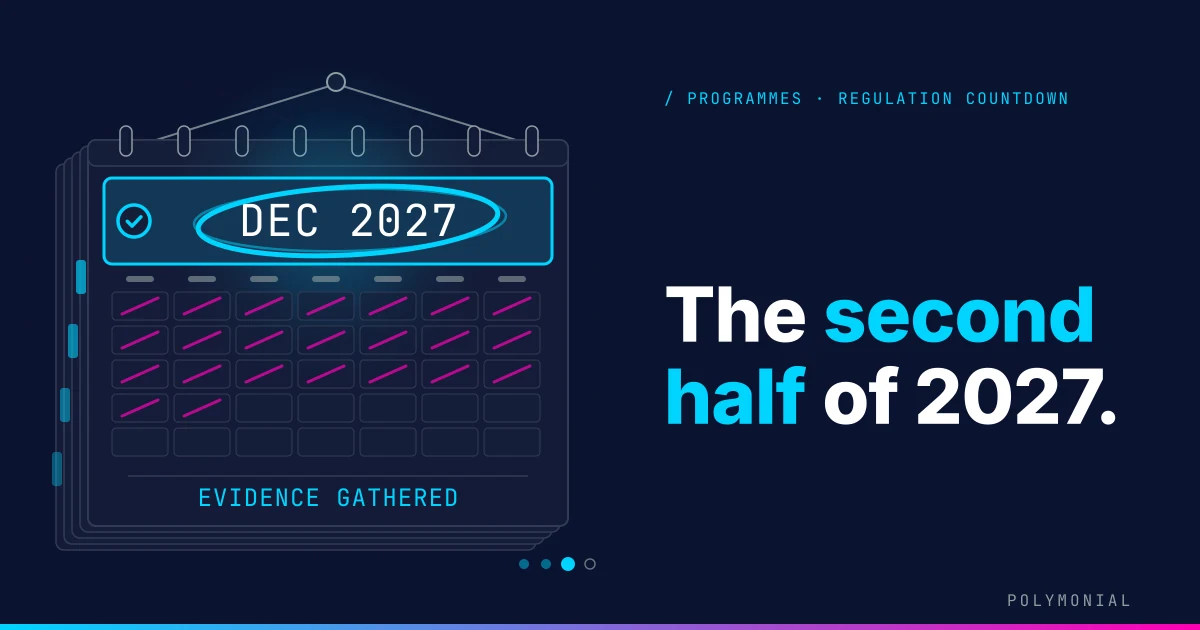
Regulation countdown, part three of four.
If one month in the regulatory calendar deserves a circle around it, it is December 2027. Three major EU rules reach their main deadlines within weeks of each other, and several more dates land in the months before. For many organisations, the second half of 2027 is when years of preparation either pay off or don't.
September to November 2027
- September 2027: the first carbon declaration. Importers covered by the Carbon Border Adjustment Mechanism file their first annual declaration, and the emissions figures behind it have to hold up.
- October 2027: UK cryptoasset regime. The FCA's new regime for cryptoasset firms serving UK customers is expected to take effect, and those firms need FCA authorisation.
- November 2027: US drug tracing. The last exemption for small dispensers under the US Drug Supply Chain Security Act ends, completing electronic, unit-level tracing of prescription drugs.
The December cluster
- High-risk AI. Stand-alone high-risk AI systems must comply with the EU AI Act from December 2027, with risk management, records and conformity in place for each one.
- Product security. The Cyber Resilience Act's main obligations apply from December 2027: secure-by-design requirements, vulnerability handling and conformity for most products with digital elements placed on the EU market from then, and for older ones when they are substantially modified.
- Forced labour. From December 2027, products made with forced labour can't be placed on, made available on or exported from the EU market, whatever the sector, origin or stage of the supply chain.
Also by the end of 2027
- Checkout codes. Retail scanners worldwide aim to read 2D codes alongside traditional barcodes by the end of 2027, carrying richer product data to the till.
- Payments. Swift plans to release a network upgrade with post-quantum protection in 2027, with a set period for connected institutions to move to it.
Why December is harder than it looks
The three December rules look unrelated: one about AI, one about product security, one about human rights in supply chains. Underneath, they ask for the same thing.
- The AI Act asks you to show how each high-risk system uses data, with records that stand up to scrutiny.
- The Cyber Resilience Act asks you to show that your products and their updates are genuine and secure, and to handle vulnerabilities on the record.
- The Forced Labour Ban asks you to show what happened at every tier of your supply chain.
Each needs evidence that comes from many systems and many hands, and that can't be quietly edited before a regulator reads it. None of it can be produced in December. It has to have been gathered all year.
Before and after: a manufacturer faces two December rules
A maker of connected consumer products uses AI to screen job applicants and sources components from several tiers of suppliers. Its products fall under the Cyber Resilience Act. (Illustrative.)
Before. Three teams prepare for three deadlines. The product team builds a conformity file from build logs and supplier statements. The sourcing team sends questionnaires down the chain. The people team asks its AI supplier for documentation. Each team keeps its own copy of the evidence, and each copy drifts. In November, the board asks whether the company is ready, and nobody can answer for all three.
After. Evidence is gathered as work happens: build and update records, supplier declarations and the AI system's use of data, each kept in a form where any later change shows. Each rule draws on the same foundation. In November, the board gets one answer, backed by records each regulator can rely on.
What good looks like
Smart Data Infrastructure turns each of these rules into a control you reuse, with data that stays secure, trusted and under your control, and evidence ready the day it's asked for. December 2027 is about a year away, which is exactly how long a year's evidence takes to gather.
Next in the series: the long quantum clock, from 2028 to 2035.
If December 2027 is on your calendar, talk to us about your compliance programme.
Related Posts
Regulation countdown: the first half of 2027
Between December 2026 and June 2027, product passports, certificate sales, machinery rules and new health milestones all arrive. What lands, and when.
Read More ›
EU AI Act dates: what applies when, and the evidence needed
The EU AI Act applies in stages, with high-risk AI due from December 2027. Each stage asks for evidence of how your AI is governed.
Read More ›
Regulation countdown: what's already live
Many of the rules reshaping how data is handled aren't future deadlines: they already apply, and supervisors want evidence now. Here's what is live.
Read More ›
Trust that travels.
Secure, trusted and under your control.