The quantum milestones, 2028–2035
The UK, the EU, US federal systems and the payments network all set post-quantum dates between 2028 and 2035. Here is the long clock, side by side.
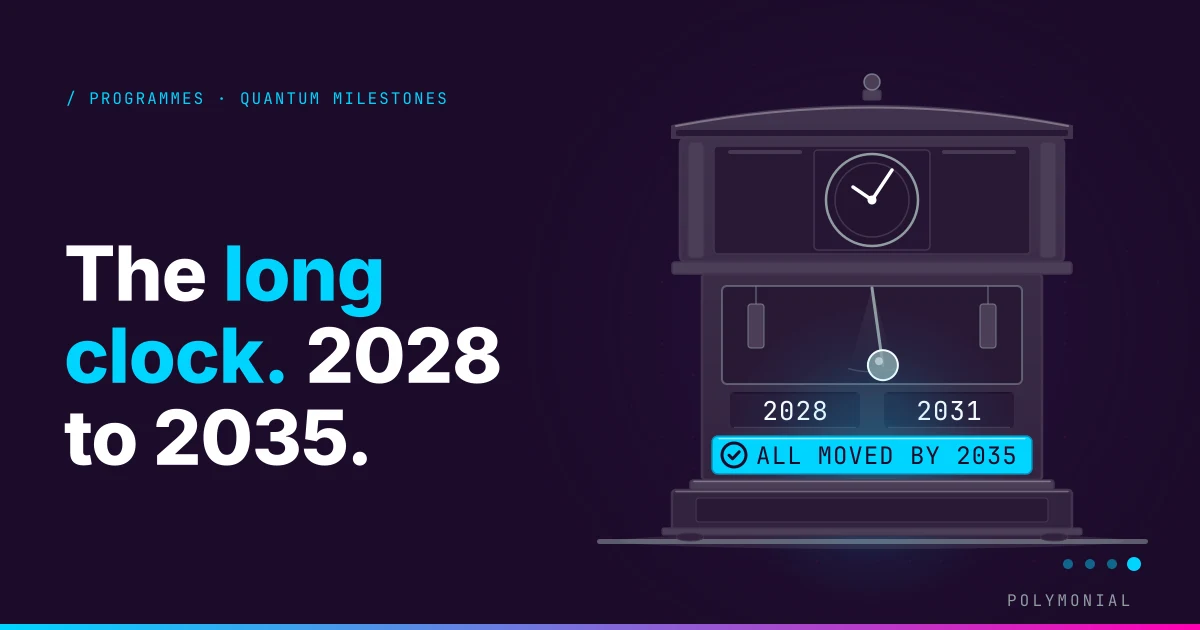
Regulation countdown, part four of four.
The first three parts of this countdown covered rules you can see from your desk: what's already in force, what lands in the first half of 2027, and the cluster at the end of 2027. This last part covers the long clock. Its milestones sit years away, which makes them easy to put off and hard to meet.
They all concern the same change. Quantum computers are expected to weaken the public-key protection that secures most of today's systems, from signed records to the connections between organisations. Governments and networks have set dates for moving to post-quantum protection. The dates are far off because the work is large, not because it can wait.
The milestones
From 2027: the payments network. Swift releases SwiftNet 8.0, its network upgraded for post-quantum protection, in 2027. Each connected institution then has a fifteen-month window to migrate, so the work runs into the period this post covers. The protection institutions use on the network changes, and each one has to move to it.
By 2028: know what you have. The UK National Cyber Security Centre sets three milestones, aimed first at large organisations and operators of critical national infrastructure. The first is to define migration goals, carry out full discovery and build an initial plan by 2028.
2028 to 2031: the highest priorities moved. In the NCSC's second stage, organisations carry out their highest-priority upgrades and refine the plan.
By the end of 2030: high-value US federal systems. Executive Order 14412 requires high-value assets and high-impact federal systems to use post-quantum protection when they establish keys, by the end of 2030. The order also calls for a change to federal procurement rules that would hold covered contractors to the same date.
By the end of 2030, then 2035: the EU's coordinated roadmap. Member States aim to move high-risk uses by the end of 2030, and medium-risk uses by the end of 2035.
By the end of 2031: US federal signatures. The same executive order requires those federal systems to use post-quantum digital signatures by the end of 2031.
2031 to 2035: everything else. The NCSC's final stage completes the migration for all systems, services and products by 2035.
Why the dates are so far apart
An organisation's protection sits in thousands of places: certificates, stored records, signed documents, partners' systems. It moves in priority order over years, and the data signed or protected along the way has to stay usable throughout. Old and new have to work side by side, because counterparties don't all move on the same day.
There's a second reason not to wait. Data you keep for decades, such as contracts, health records, property records and long-term financial records, can be copied today and read later, once the threat arrives. For those records, the clock is already running.
Before and after: the 2028 discovery work
A UK organisation that runs regulated systems starts the discovery stage of its plan. (Illustrative.)
Before. The security team sends a spreadsheet to every system owner, asking where public-key protection is used. Answers come back months later, incomplete and in different formats. Nobody can say which stored records must stay trusted for decades, or which partners depend on them. The plan due by 2028 rests on guesses, and the priority list changes every time someone finds another system.
After. The organisation knows which of its data matters most and how long each record has to stay trusted. It moves those first, at its own pace. Data it shares stays under its control. Systems keep running while the move is under way, and records signed before the move can still be checked after it.
What to do now
- Start with an inventory. Every later milestone depends on knowing what you have and where it sits.
- Rank by lifetime. The records you keep longest are the ones most exposed to being copied now and read later.
- Plan for overlap. Expect years in which some partners and suppliers have moved and others haven't.
- Keep trust in the past. Records signed before the move still have to be relied on after it.
- Read the dates as one clock. If you operate in the UK or the EU, serve US federal customers or connect to the payments network, more than one of these timetables applies to you at once.
That's the end of the countdown. Across four parts, the message is the same: the rules are set, the dates are public, and the organisations that meet them comfortably are the ones that start with the data they already hold.
If your organisation has a post-quantum deadline anywhere between 2028 and 2035, talk to us about your migration programme.
Related Posts
The perfect storm: four forces converging on your business
Sovereignty, Quantum, Regulation and AI are arriving at once. Each raises the cost of holding data, and each can become value when your data proves itself.
Read More ›
EU AI Act dates: what applies when, and the evidence needed
The EU AI Act applies in stages, with high-risk AI due from December 2027. Each stage asks for evidence of how your AI is governed.
Read More ›
The UK PQC timeline: 2028, 2031, 2035
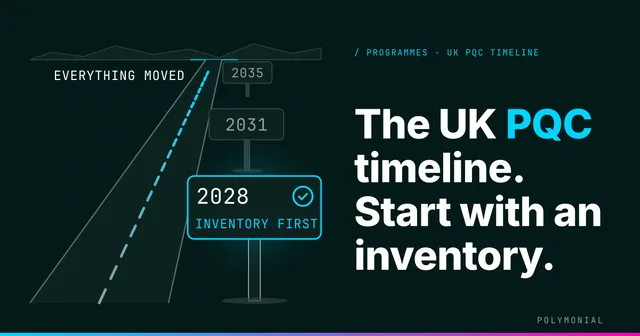
The NCSC sets three milestones for moving UK systems to post-quantum protection. The first, by 2028, starts with knowing what you hold.
Read More ›
Trust that travels.
Secure, trusted and under your control.