Retail and supply chain: provenance customers can believe
Shoppers, regulators and campaigners all want to know where products come from. A provenance claim only counts when it can be checked.
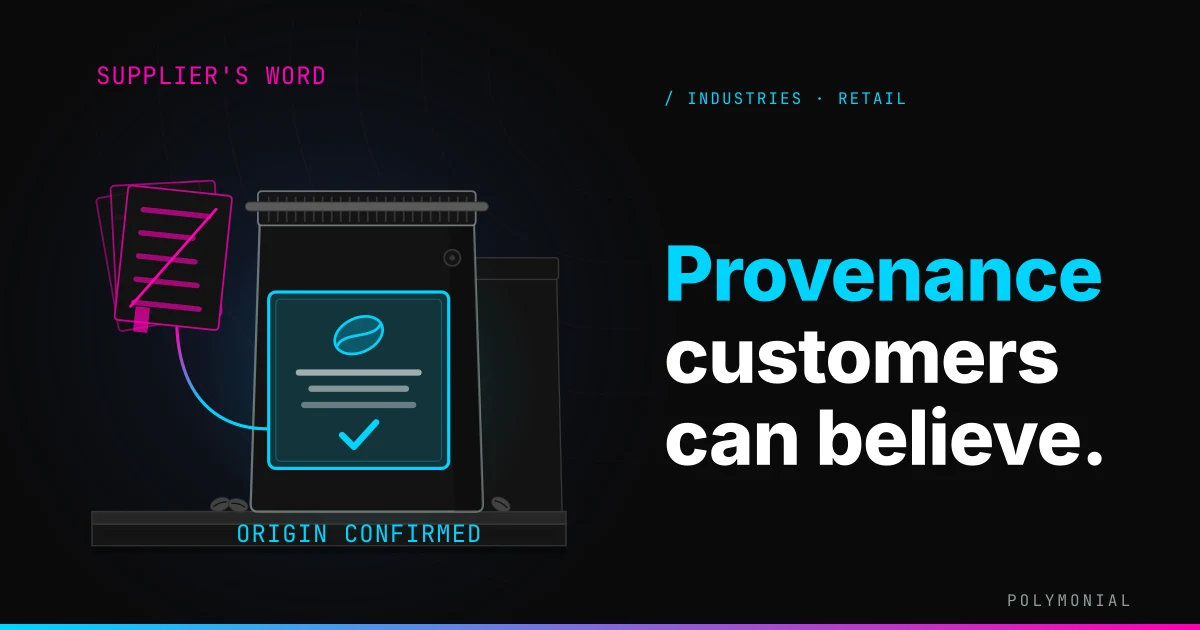
A label says the cotton is organic, the coffee is deforestation-free, the fish was caught responsibly, the packaging is recycled. Many customers choose on claims like these, and say they will pay more for them. But the evidence behind each claim usually sits several steps up the supply chain, with suppliers the retailer has never dealt with directly.
When a journalist, a campaigner or a regulator asks "how do you know?", too many answers come down to a supplier's word.
Why provenance is hard
Supply chains are long and layered. A garment passes from farm to spinner to mill to factory to shipper before it reaches a distribution centre. Each tier keeps its own records, in its own systems, and shares as little as it can, often for sound commercial reasons.
The evidence that does reach the retailer arrives as certificates, audit reports and spreadsheets. They're easy to copy, hard to check and quick to go out of date. And because suppliers are wary of revealing their own sources, the retailer often can't see past the first or second tier at all.
The rules are tightening
From December 2026, large operators placing commodities such as cocoa, coffee, palm oil, soy, cattle, rubber and wood on the EU market must show they're deforestation-free and legally produced. From December 2027, goods made with forced labour can't be sold in or exported from the EU, whatever the sector. Retailers aim to have tills reading 2D codes by the end of 2027, carrying richer product data to the point of sale. Each change asks the same thing: show it, don't just say it.
Customers are tightening their expectations too. A claim that turns out to be unfounded costs more than a fine: it costs the trust that made the claim worth making.
Before and after: a sourcing claim is challenged
A retailer sells an own-brand coffee labelled as responsibly sourced. A campaign group questions the claim. (Illustrative.)
Before. The sourcing team asks its importer for evidence. The importer asks its exporter, who asks the cooperative. Weeks later a bundle of certificates arrives, some expired, one for a different farm. The retailer can't tell which documents relate to which shipments, and the cooperative won't share its member list. The retailer issues a holding statement and hopes the story moves on.
After. Each tier's evidence was captured when the coffee changed hands, and can be checked by the retailer directly. The retailer checks the claim against that evidence directly: origin confirmed, standards met, each shipment accounted for. Suppliers share what the claim needs without handing over their commercial relationships. The retailer answers quickly, with evidence the campaign group's own experts can check.
What changes with Smart Data Infrastructure
- Supplier evidence the retailer can check, from origin to shelf.
- Evidence shared only with the parties entitled to it, so suppliers can take part without exposing their own sources.
- Evidence that keeps its trust as it moves between suppliers, systems and borders.
- Claims checked, not just asserted, before they reach a label or a till.
The data stays secure, trusted and under the control of the supplier that holds it, while the retailer gets the answer it needs.
What it means for your teams
Sourcing and compliance teams stop chasing paperwork and start checking claims.
Marketing teams make claims they can back with evidence.
Suppliers gain a way to show they meet standards without giving away their supply base.
Legal and risk teams answer regulators and campaigners from evidence rather than reassurance.
Store and online teams can show customers the story behind a product, with evidence behind it.
Beyond the label
The same approach serves recalls (which batches came from which source), resale (is this item genuine?) and the product data that increasingly travels with goods themselves. In each case the customer, the regulator or the next buyer needs a fact about the product, with evidence that holds up.
The next two years
The rules arrive one after another over the next two years, and each needs evidence from suppliers you don't control. Building that evidence once, in a form every tier can use, is far easier than answering each rule with its own scramble.
If you sell, source or certify products, talk to us about your sector.
Related Posts
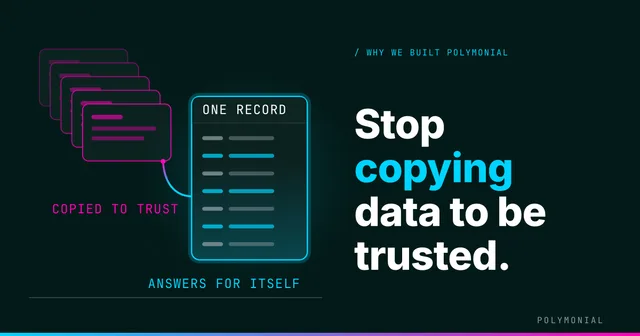
Why we built Polymonial: data trusted without copies
For decades, data has had to be copied to be trusted. We built Polymonial so that data can answer for itself, wherever it goes.
Read More ›
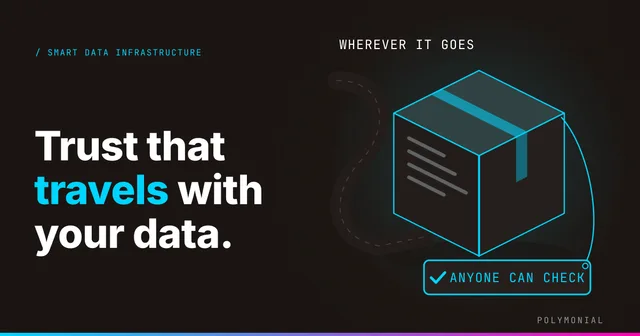
What is Smart Data Infrastructure?
Smart Data Infrastructure keeps your data secure, trusted and under your control, so you can share it, store it and use it without losing hold of it.
Read More ›
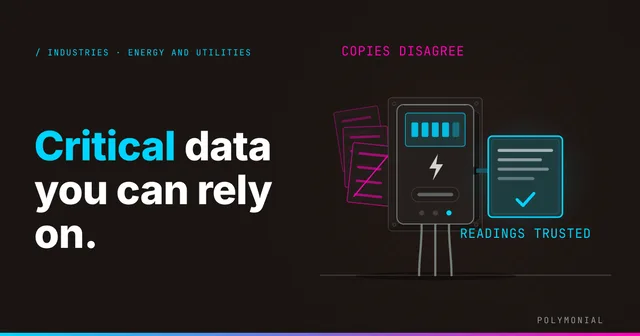
Energy and utilities: critical data you can rely on
Meters, networks and suppliers all depend on data they didn't create. Energy runs better when every party can rely on the readings it receives.
Read More ›
Trust that travels.
Secure, trusted and under your control.