The Data Act and connected-product makers
Most connected products placed on the EU market after September 2026 must let users reach their data. Makers can share it fairly and still keep control.
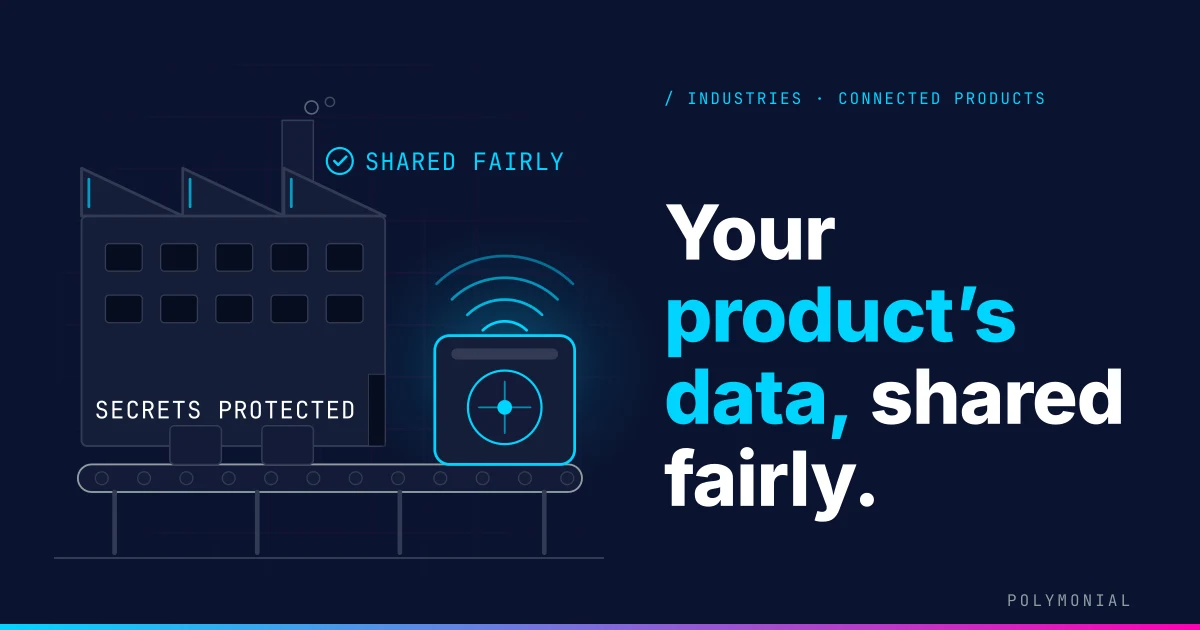
Every connected product generates data. A tractor reports on soil and fuel. A lift logs its faults. A heat pump tracks how a home is heated. A machine tool records its own wear. For years, the maker held most of that data and decided who else saw it.
The EU Data Act changes that balance. The people and businesses who use a connected product get a say over the data it generates: they can see it, and they can ask for it to be shared with a service of their choosing, such as an independent repairer or a rival maintenance provider.
The Act has applied since September 2025. Connected products and related services placed on the market after September 2026 must be designed so users can reach their data easily and securely, unless the maker is a micro or small business. From September 2027, its rules on unfair data-sharing terms also cover older long-running contracts.
For makers, that's a new kind of request arriving at the support desk, and a new set of worries.
What makers worry about
The concerns are reasonable ones.
- Trade secrets. Product data can reveal how a product is designed, tuned and made.
- Copies you can't follow. Once data is handed over, a maker can't see where it goes next.
- Disputes. When a user, a repairer and a maker disagree about what was shared, each holds a different version of events.
- Cost. Data access has to be designed into every product line and related service, and every request handled by hand is engineering time not spent on the product.
Before and after: a repair request
A business running a fleet of connected machines asks for their operating data to go to an independent repairer. (Illustrative.)
Before. The maker's support team exports a spreadsheet, strips out the fields it thinks are sensitive and emails it. The repairer says it's incomplete. The customer complains that it took weeks. Nobody can show afterwards exactly what was sent, and the maker has no idea how many copies of its product data now exist, or where.
After. The customer authorises the repairer, and the repairer receives exactly the data the request covers, with the maker's trade secrets kept protected. Every share leaves a record that all three parties can check. The repair goes ahead, the customer gets what the law gives them, and the maker keeps control of everything it never had to hand over.
What it means for makers
- Share fairly, keep control. Users get their data; your sensitive design detail stays protected.
- Answer requests without a project. Each request follows the same rules, rather than a fresh negotiation.
- Settle disputes with evidence. What was shared, with whom and when is on record.
- Turn openness into a reason to buy. Customers who want to use their own data have a reason to choose your product.
The Data Act doesn't ask makers to give up control. It asks them to share fairly. With the right foundations, product data stays secure, trusted and under your control while it reaches the people entitled to it, and each request follows the same path instead of starting from scratch. Most new connected product lines now have to be designed for data access, so the foundations are worth setting before the next launch.
If you make connected products for the EU market, talk to us about your sector.
Related Posts
The Cyber Resilience Act: report on time, with evidence
Manufacturers selling into the EU now report exploited vulnerabilities and severe incidents, with design duties from December 2027. Answer with evidence.
Read More ›
Sharing data without losing control of it
The EU Data Act expects more data to be shared. Sharing used to mean handing over a copy and hoping, but it no longer has to.
Read More ›
It covers non-personal data too
The EU Data Act isn't only about personal data. Machine, product and operational data are in scope too, and many organisations haven't noticed.
Read More ›
Trust that travels.
Secure, trusted and under your control.