Switching cloud provider under the EU Data Act
The EU Data Act makes it easier to switch cloud provider. The harder part is arriving with the evidence that your data was handled properly.
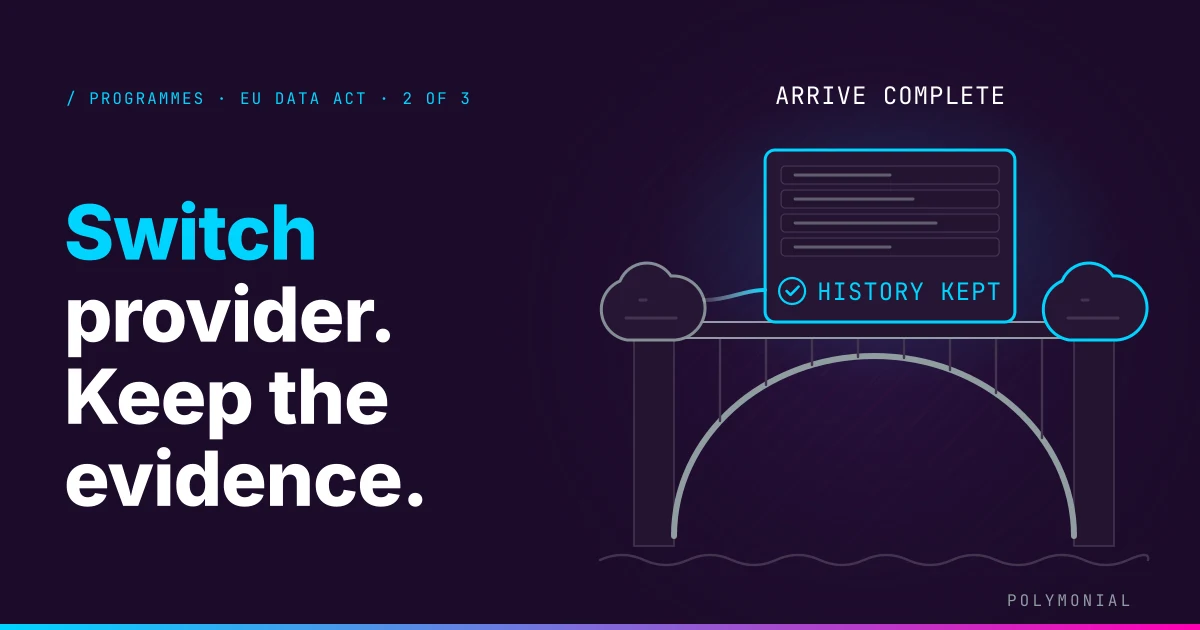
The EU Data Act in three parts, part two.
Ask most organisations whether they could leave their cloud provider and the honest answer is "in theory". In practice, years of data, configuration and integrations sit in one provider's systems. Moving them is a large project, and the risk of something going wrong on the way is enough to make many organisations stay where they are, even when a better option exists.
The EU Data Act, which has applied since September 2025, sets out to change that. It requires providers of cloud and similar data-processing services to remove the obstacles that stop customers switching, whether commercial, technical or contractual, and to support customers through the move. The aim is a market where organisations choose a provider because it serves them best, not because leaving is too hard.
That's welcome. But making a switch possible doesn't make it safe. The question that remains is whether your data, and the evidence about it, arrives intact.
What a switch puts at risk
A cloud migration moves more than files. It moves the history that makes those files trustworthy.
- Completeness. Did every record arrive, or did some fall through the gaps between the old system and the new one?
- Integrity. Is each record exactly what it was before the move, or was something altered, truncated or reformatted on the way?
- History. Records of who accessed data, when and under what rules often live in the old provider's own tools. They don't always travel with the data.
- Continuity of control. For a period, data sits in two places at once. Who controls each copy, and when is the old one truly gone?
- The audit trail. After the move, can you still show an auditor or regulator what happened to the data before it?
Each of these is manageable on its own. Together, they're why switching providers has traditionally been treated as a high-risk event, signed off with crossed fingers.
Evidence that travels with the data
The usual way to reduce that risk is effort: reconciliation scripts, sample checks, long parallel running and detailed sign-off documents. Effort helps, but it leaves an organisation relying on its own reconstruction of what happened.
A better starting point is data that carries its own evidence. When records stay secure, trusted and under your control wherever they're held, the evidence about them isn't tied to any one provider's tools. It moves with the data, and it can be checked on either side of the move.
That changes the questions at the end of a migration. Instead of "do we think everything arrived?", the team can ask "does every record check out?", and get a clear answer.
Before and after: moving a regulated workload
A financial services firm decides to move a regulated workload, including several years of customer records and their access history, to a new cloud provider. (Illustrative.)
Before. The migration team spends months planning. It exports data in batches, writes scripts to compare row counts and samples records by hand. The access history from the old provider's logging service doesn't fit the new provider's format, so it's archived separately as a set of files. Parallel running lasts longer than planned because nobody is confident enough to switch off the old system. A year later, an auditor asks who accessed a particular customer record before the move. Answering means retrieving the archive and piecing the story together by hand.
After. The firm's records carry their own evidence, independent of either provider. As data arrives at the new provider, every record is checked on arrival, and the team can see straight away that nothing is missing or altered. The history of who used the data, and under what rules, comes across with it. Parallel running ends when the checks pass, not when nerves allow. When the auditor asks the same question a year later, the answer is the same as it would have been before the move.
What it means in practice
- Switch on your own timetable. The decision to move is about which provider serves you best, not about how hard leaving would be.
- Arrive complete. You can show that every record made the move, unchanged.
- Keep your history. The evidence about how data was handled before the move stays usable after it.
- End parallel running with confidence. The old copy can go once the new one checks out.
- Answer auditors the same way, before and after. A change of provider doesn't create a gap in the record.
Getting ready, whether or not you plan to move
Even organisations with no plans to switch benefit from being able to. The ability to leave strengthens every negotiation with a provider, and it's a sign of good control over your own data.
- Know what you'd need to take. List the data, and the evidence about the data, that would have to move with you.
- Check where your history lives. If access records and audit trails only exist in a provider's own tools, plan how they would travel.
- Read your contracts with switching in mind. The Data Act changes what providers can impose; make sure your agreements reflect it.
- Test a small move. Moving a low-risk workload end to end shows where the real gaps are.
- Make your data independent of any one provider. The more your evidence travels with the data, the less any provider holds you in place.
Where this fits in the series
In part one we looked at sharing data without losing control of it. Switching provider is a special case of the same idea: data moving from one party to another, with its owner still in charge. In part three we look at why the Data Act covers non-personal data too, and what that means for organisations whose data has never been regulated before.
Being free to switch provider is only valuable if you can arrive with everything you left with. When your data is secure, trusted and under your control, your provider is a choice you keep making, not one you are stuck with.
The Data Act already applies, so the freedom to switch is there to use. If you're planning a cloud move, or want the freedom to make one, talk to us about your migration programme.
Related Posts
Sharing data without losing control of it
The EU Data Act expects more data to be shared. Sharing used to mean handing over a copy and hoping, but it no longer has to.
Read More ›
The Data Act and connected-product makers
Most connected products placed on the EU market after September 2026 must let users reach their data. Makers can share it fairly and still keep control.
Read More ›
Retail and supply chain: provenance customers can believe
Shoppers, regulators and campaigners all want to know where products come from. A provenance claim only counts when it can be checked.
Read More ›
Trust that travels.
Secure, trusted and under your control.