What boards are now accountable for
NIS2 puts cyber risk on the board's agenda and in its name. Directors need answers they can stand behind, not reassurance they have to take on trust.
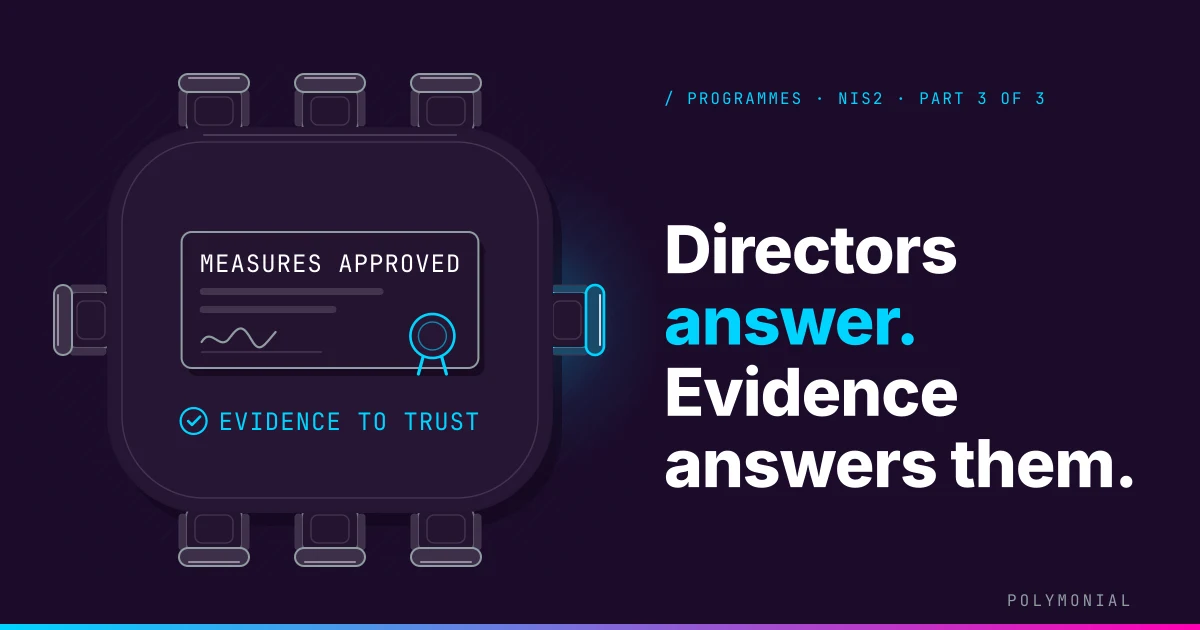
NIS2 in three parts, part three.
For years, cyber security reached most boards as a standing item near the end of the agenda. A senior technology leader presented a slide with a risk rating, a list of projects and a reassurance that the organisation was in good shape. Directors asked a few questions, noted the update and moved on.
NIS2 changes the weight of that item. It places responsibility for managing cyber risk with the organisation's management body. Directors are expected to approve the measures the organisation takes, oversee how those measures are put into practice, and understand the risks well enough to do both. When the measures fall short, the questions go to the top.
That's a different position from receiving an update. It means directors need to know that what they're told is true.
What accountability asks of a director
Being accountable for something you don't run day to day is a familiar part of a director's role. Boards already answer for financial statements they didn't prepare and for safety systems they didn't design. What makes it workable is evidence: audited accounts, inspection records, independent checks.
Cyber risk has rarely come with evidence of that kind. Directors are typically offered three things.
- Ratings. A traffic-light score or a maturity level, which summarises a judgement but doesn't show what it rests on.
- Activity. A list of projects, tools bought and training completed, which shows effort but not outcome.
- Assurances. Statements from management, suppliers and advisers that controls are in place, which are only as reliable as the people giving them.
None of these is useless. But none of them lets a director check, independently, that the organisation's most important data is protected in the way the board was told.
The questions directors are starting to ask
As accountability sharpens, the questions in the boardroom are changing. Directors who expect to answer for cyber risk are asking:
- How do we know? When we're told a control works, what is the evidence, and who has seen it?
- What would we say on the first day? If a significant incident happened tonight, could we stand behind what we report? Part one of this series looked at the early warning NIS2 expects.
- What do our suppliers actually do with our data? Part two looked at why a folder of questionnaires no longer carries that weight.
- Would the answer survive scrutiny? If an authority, an auditor or a court asked us to show our working, could we?
These are reasonable questions. They're also hard ones for management to answer, because the evidence often isn't there to be shown.
Before and after: the board asks about customer data
A board is reviewing cyber risk after a competitor's well-publicised breach. One director asks a simple question: if the same thing happened here, how confident are we about what would be exposed? (Illustrative.)
Before. Management presents a green rating for data protection and a list of recent improvements. The director asks what sits behind the rating. The answer is a combination of policy documents, a recent internal review and supplier attestations. Nobody in the room can say with certainty where the most sensitive customer data is held, which suppliers have copies, or whether the controls described were working last month. The board notes the update and asks for a deep dive next quarter. Each director privately wonders what they would say if asked to explain it.
After. Management presents the same rating, and behind it, evidence the board can rely on. The organisation's sensitive data stays secure, trusted and under its control, and there's a record of where it is, who has used it and under what rules. The director's question gets a direct answer, with evidence that an auditor or authority could check for themselves. The board spends its time on the decisions that matter: where to invest, which risks to accept and what to change.
What good looks like
Boards don't need to become technical experts. They need confidence that the information reaching them is reliable. In practice, that tends to mean a few things.
- Evidence over ratings. Every summary the board sees can be traced back to something that can be checked.
- The most important data first. The board knows which data matters most to the organisation and how it's protected, rather than receiving an average across everything.
- Suppliers included. Assurance about data held by suppliers is as strong as assurance about data held in-house.
- Incidents rehearsed. The organisation has rehearsed how it would report, and the board knows its own role in that process.
- Directors who understand the risks. Training is about asking good questions, not learning the technology.
- A record of the board's own oversight. Minutes and decisions show what directors asked, what they were shown and what they decided.
Why this matters beyond compliance
It would be easy to treat board accountability as one more compliance task. It's more useful to see it as a shift in what good governance means. Customers, investors, insurers and partners increasingly ask the same questions directors are now asking, and they want the same kind of answer: not "we take security seriously", but "here is how you can check".
The pressures behind this go beyond any single regulation. Four forces are converging on every organisation: Sovereignty, Quantum, Regulation and AI. All four land on its data and compute, and Smart Data Infrastructure is the layer under all four. A board that can see evidence about its data is better placed to answer for every one of them.
The series in summary
Across three parts, NIS2's demands come down to one idea. Reporting an incident on time, managing suppliers and answering as a board all depend on evidence you can trust before anything goes wrong. Organisations that build that evidence into how they handle data will find each obligation easier to meet, and each conversation with an authority shorter.
If your board is preparing to answer for cyber risk under NIS2, talk to us about your governance programme.
Related Posts
The NIS2 early warning, without the scramble
NIS2 expects an early warning soon after a significant incident. The teams that report calmly are the ones that already trust their records.
Read More ›
Your supply chain: evidence instead of questionnaires
NIS2 makes supplier security part of your own. Questionnaires describe what suppliers say they do; evidence shows what actually happened.
Read More ›
NIS2 for managed service providers: clients answer for you
Under NIS2, most managed-service providers are regulated in their own right, and their clients must answer for them too. Evidence beats questionnaires.
Read More ›
Trust that travels.
Secure, trusted and under your control.