Your supply chain: evidence instead of questionnaires
NIS2 makes supplier security part of your own. Questionnaires describe what suppliers say they do; evidence shows what actually happened.
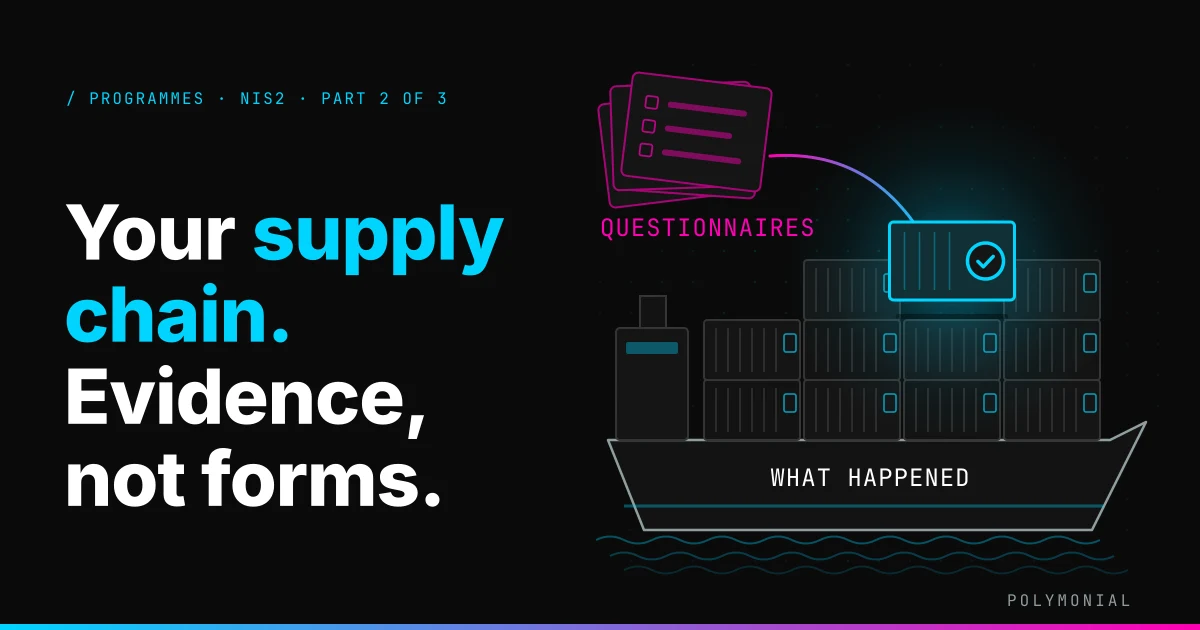
NIS2 in three parts, part two.
Every organisation depends on suppliers it doesn't control. Cloud platforms, software vendors, managed service providers, payroll bureaux, logistics firms, specialist contractors: each one touches your systems or your data, and each one could be the way in for an attacker.
NIS2 treats that as your problem, not just theirs. Essential and important entities are expected to address the security of their supply chain as part of managing their own cyber risk. When something goes wrong at a supplier, the question from the authority, the board and the customer is the same: what did you know, and how did you know it?
For most organisations, the honest answer is a folder of questionnaires.
The questionnaire problem
The supplier questionnaire is the standard tool of third-party assurance. It's familiar, it's cheap to send, and it produces a tidy file. It also has well-known limits.
- It records what a supplier says, not what it does. A confident answer and a working control look the same on paper.
- It's out of date as soon as it's returned. Suppliers change systems, staff and subcontractors all year round. The questionnaire describes one moment.
- It's the same for everyone. A supplier that holds your most sensitive data answers broadly the same questions as one that delivers office supplies.
- It multiplies. Large suppliers fill in many slightly different versions for different customers, and small ones struggle to fill in any.
- It can't be checked. When a questionnaire says data is handled in a certain way, the customer usually has no means of confirming it.
None of this is the fault of the people who send or answer questionnaires. It's what happens when assurance depends on description rather than evidence.
What evidence looks like
Evidence about a supplier answers a narrower, harder question. Not "do you have a policy?", but "what happened to our data, and can we check it?"
That kind of evidence has a few properties in common.
- It's about your data, specifically. It shows where your data went, who handled it and under what rules, rather than describing the supplier's general approach.
- It's current. It reflects what is happening now, not what was true when the form was filled in.
- It can be checked without trusting the supplier's word. You, your auditor or your regulator can confirm it independently.
- It reveals what's needed and no more. A supplier can show that a rule was met without handing over its whole operation for inspection.
Evidence like this doesn't replace the relationship with a supplier. It changes the conversation, from "please confirm that you comply" to "here is what happened, and here is how you can see it for yourself".
Before and after: a supplier incident
A payroll provider used by a regulated operator reports that one of its systems was breached. (Illustrative.)
Before. The operator's third-party risk team opens the provider's file. The latest questionnaire is from the previous year and says employee data is restricted to a small team and kept in one region. Nobody can confirm whether that was still true at the time of the breach. The team sends a list of urgent questions and waits. The board wants to know whether employee data was exposed. The authority wants to know what the operator did to manage the risk. For several days, the operator can only say that it is waiting to hear back.
After. The operator's data stays secure, trusted and under its control when it reaches the provider. When the breach is reported, the operator can see for itself what data the provider held, where it was handled and under which rules, without waiting for the supplier's account. It tells the board quickly which records were in scope. It shows the authority the evidence it relied on, not a year-old form. Its follow-up with the provider is about fixing the problem, not establishing the facts.
Where to start
Moving from questionnaires to evidence doesn't happen in one step, and it doesn't have to. A few practical moves make the most difference.
- Rank suppliers by what they hold. Start with the suppliers that handle your most sensitive data or run your most critical services. They're where evidence matters most.
- Ask about your data, not their policies. For those suppliers, agree what evidence you need about how your data is handled, and how often.
- Build it into contracts. New and renewing contracts are the natural place to set expectations about evidence, notification and cooperation during incidents.
- Share less in the first place. The safest data at a supplier is data it never needed. Each supplier should receive only what its service requires.
- Connect it to incident reporting. In part one we looked at the early warning NIS2 expects soon after a significant incident. Evidence from suppliers is often what decides whether that report goes out on time.
- Keep the questionnaire where it helps. For low-risk suppliers, a short questionnaire may still be proportionate. The aim is to stop relying on it where it can't carry the weight.
Why suppliers benefit too
Evidence isn't only a burden placed on suppliers. For many, it's a relief. A supplier that can show customers what happened to their data, on request, spends less time on repetitive questionnaires and less time defending itself after an incident. In competitive markets, being able to offer evidence rather than assurances is a reason to be chosen. And for smaller suppliers, who often struggle with long questionnaires, it's a way to show their strengths without a compliance team behind them.
What comes next in this series
In part three we turn to the boardroom. NIS2 places responsibility for cyber risk with the people at the top of the organisation, and directors are starting to ask what evidence sits behind the assurances they receive, including the assurances about suppliers.
If you're reviewing how your organisation manages supplier risk under NIS2, talk to us about your third-party assurance programme.
Related Posts
DORA in practice: answering for every technology supplier
DORA makes EU financial firms prove their resilience, including every technology supplier they rely on. The hard part is evidence that stands up.
Read More ›
The NIS2 early warning, without the scramble
NIS2 expects an early warning soon after a significant incident. The teams that report calmly are the ones that already trust their records.
Read More ›
NIS2 for managed service providers: clients answer for you
Under NIS2, most managed-service providers are regulated in their own right, and their clients must answer for them too. Evidence beats questionnaires.
Read More ›
Trust that travels.
Secure, trusted and under your control.